
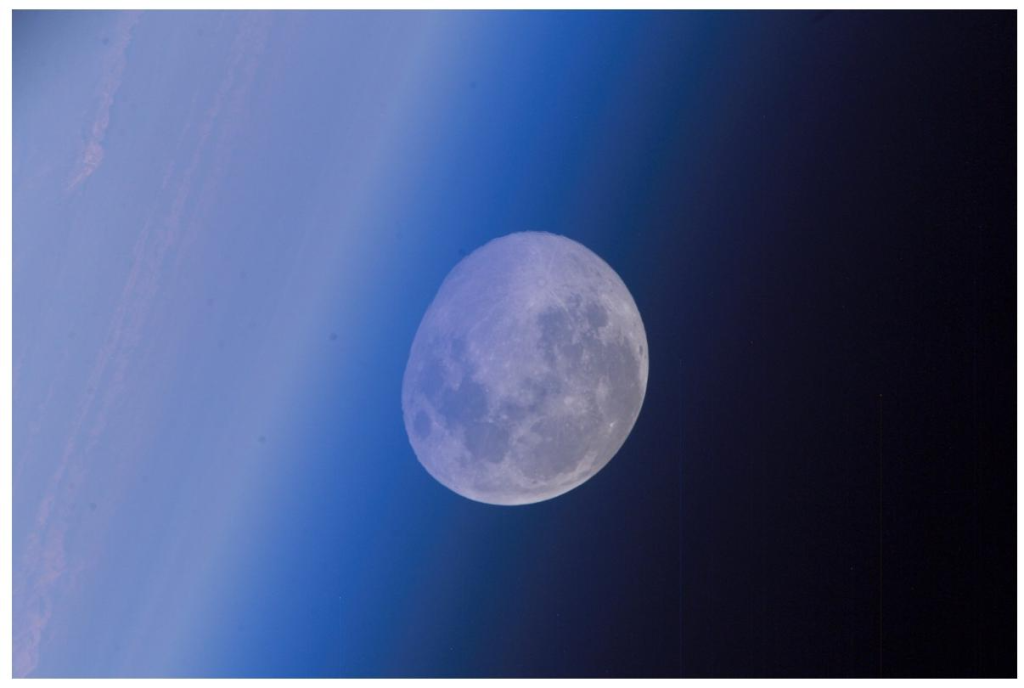
The Moon is Earth’s companion and one of the night sky’s most captivating sights. The night sky is a canvas of celestial wonders, and the Moon is a standout feature. Its soft glow has inspired poets, guided navigators, and sparked human curiosity. As our closest neighbor, the Moon holds secrets that help us understand Earth and the solar system. Let’s explore its size, composition, distance from Earth, and why its phases change.
How Big Is the Moon?
The Moon is Earth’s only permanent natural satellite and the fifth-largest satellite in the solar system. Its diameter is approximately 3,475 km (2,160 miles)—roughly the distance of a flight from New York City to Las Vegas. This means the Moon’s width is about a quarter of Earth’s, which has a diameter of around 12,750 km (7,920 miles).
Despite being smaller than Earth, the Moon’s surface area could easily fit all of North and South America.
What Is the Moon Made Of?
The Moon’s outer layer is a thin rocky crust, composed of oxygen, silicon, magnesium, iron, calcium, aluminum, and trace elements like potassium, titanium, and uranium. Beneath the surface lies the mantle, made of minerals such as olivine and pyroxene. The lunar core is much smaller and less dense than Earth’s, primarily consisting of iron. However, the Moon lacks a global magnetic field, indicating its core is solid rather than molten like Earth’s.
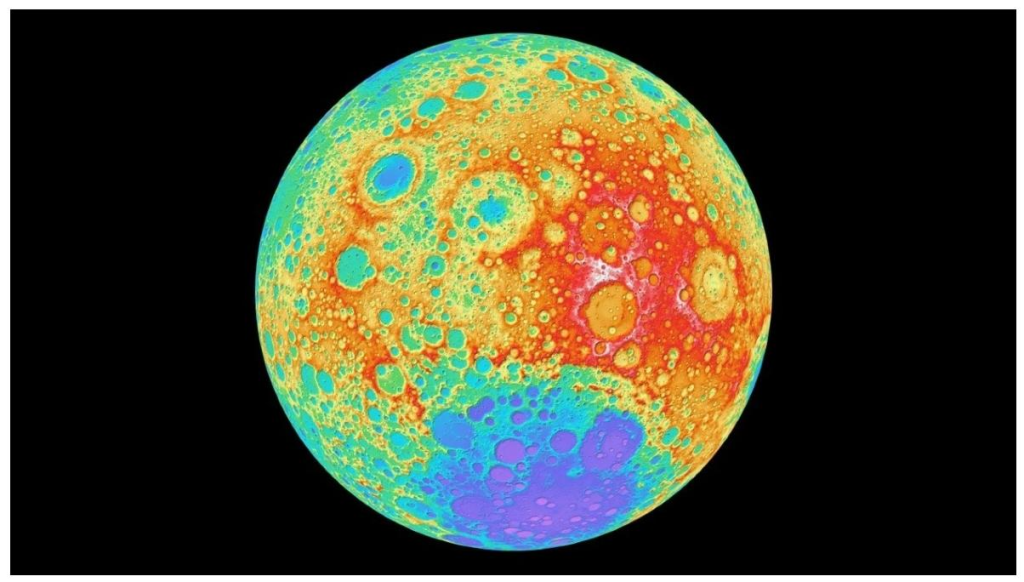
The lunar surface is dominated by rocky terrain, dotted with dark, flat maria—ancient asteroid impact basins filled by lava that cooled and solidified billions of years ago. Maria are dark and smooth; older highlands are lighter and rugged, shaped by countless impacts over time. The entire surface is covered in a fine, charcoal-colored regolith, formed by billions of years of meteoroid and micrometeoroid impacts.
Scientists have even detected traces of water ice on the Moon over the years, particularly at the bottom of permanently shadowed craters near the south pole. In fact, the presence of this water ice is a key reason NASA plans to send astronauts to the lunar south pole in the upcoming Artemis mission. After all, readily available water will be critical for establishing and sustaining future human settlements on the Moon.
How Far Is the Moon from Earth?
The average distance between the Moon and Earth is about 384,400 km (238,900 miles). Due to the Moon’s elliptical orbit around Earth, this distance varies. At perigee, its closest point, the Moon is approximately 363,000 km (226,000 miles) from Earth. At apogee, its farthest point, it is about 405,000 km (252,000 miles) away.
This variation in distance is why we sometimes see supermoons. A supermoon occurs when a full moon coincides with the Moon being at perigee, making it appear slightly larger and brighter in the sky. While noticeable, the difference isn’t dramatic: a supermoon appears only about 7% larger than a typical full moon.
Why Does the Moon Have Phases?
Lunar phases—the Moon’s changing appearance—result from shifting orbital geometry between the Sun, Moon, and Earth, making them a defining feature. There are eight primary phases, repeating roughly every 29.5 days: During the new moon, the Moon lies between the Sun and Earth, with its dark side facing us, and solar eclipses can occur. The waxing phases follow, with the illuminated portion growing from a sliver to a half-moon (first quarter) and beyond (gibbous) until the full moon, when Earth is between the Sun and Moon, fully illuminating the Moon’s face, and lunar eclipses can occur. The waning phases then shrink the illuminated portion back to a half-moon (last quarter) and sliver (crescent) before returning to new moon.
The Moon, Our Closest Neighbor
For billions of years, the Moon has been Earth’s steadfast companion. Its size, distance, and phases have profoundly shaped Earth’s history and daily life. To this day, it remains a source of fascination for amateur astronomers and curious enthusiasts alike.
Studying and understanding the Moon deepens our knowledge of the universe and our place within it. So, the next time you gaze at the Moon, remember there’s far more to it than meets the eye.
When to See Full Moons and Lunar Phases
Here’s a schedule of 2025 full moons and their traditional names. A full moon occurs when Earth is between the Sun and Moon, fully illuminating the side of the Moon facing us. As the Moon orbits Earth, changing angles of sunlight create different phases.