The universe is a tapestry woven with threads of logic and mystery. From the predictable arc of a thrown stone to the bewildering behavior of particles at the quantum level, the laws of physics and mathematics provide the language we use to describe reality. Yet, this language often leads us to conclusions that defy our everyday intuition, presenting us with paradoxes and principles that force us to reconsider the very nature of space, time, and existence. These are not mere intellectual puzzles; they are gateways to a deeper understanding of the cosmos.
This guide embarks on a journey through some of the most profound and mind-bending concepts at the intersection of mathematics, physics, and philosophy. We will explore how a simple rolling wheel can challenge our understanding of motion, how nature finds the most efficient path for light and matter, and how the concept of infinity shatters our finite perceptions. We will then scale up to the cosmic level, examining the improbable existence of life and the radical theories that place our entire universe within a black hole. Each concept serves as a stepping stone, revealing the intricate and often paradoxical logic that underpins our reality.
The Wheel Paradox: Motion and Contradiction
One of the oldest and most elegant paradoxes in physics comes from ancient Greece, attributed to Aristotle. Known as the Wheel Paradox or Aristotle’s Wheel, it presents a simple scenario with a deeply counter-intuitive conclusion. It forces us to confront the relationship between rotational and linear motion and highlights the limitations of our intuition when dealing with concepts like infinity and continuous motion.
The Setup of the Paradox
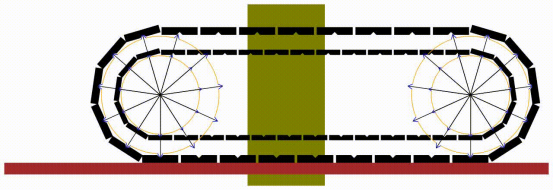
Imagine two concentric circles, a larger wheel and a smaller wheel, fixed together on the same axle, like a traditional train wheel with its flange. Now, let’s roll this combined wheel along a straight track for one full revolution without any slipping. The point of contact on the larger wheel traces a path on the track equal to its circumference. Simultaneously, the smaller, inner wheel also completes one full revolution. It, too, seems to trace a path of the same length. Herein lies the paradox: how can two circles with different circumferences travel the same linear distance in a single revolution? It seems to imply their circumferences are equal, which is a geometric impossibility.
Deconstructing the Flawed Logic
The resolution to this paradox lies in understanding the nature of the point of contact. While the larger wheel rolls smoothly along the track, the smaller wheel does not. Its motion is a combination of rolling and slipping. For every point on the smaller wheel, its path is not a simple straight line but a more complex curve known as a curtate cycloid. The points on the smaller wheel’s circumference are not continuously in contact with a surface; instead, they move forward and backward relative to the ground as the entire apparatus moves forward. The illusion is that both wheels “unroll” their circumference onto the track. In reality, only the larger wheel does this. The smaller wheel is carried along, and its rotational motion doesn’t directly translate to the linear distance covered in the same way.

The Principle of Least Action and Nature’s Efficiency
Moving from a mechanical paradox to a fundamental principle of nature, we encounter the Principle of Least Action. This profound concept suggests that in any physical process, nature will always choose the path of greatest efficiency. It’s not about the shortest distance (a straight line) but about minimizing a quantity called “action” over time, which is related to the system’s kinetic and potential energy. This principle governs everything from the path of a light ray to the orbit of a planet, revealing an underlying elegance and economy in the universe’s operations.
The Brachistochrone Problem: The Fastest Path
A classic illustration of this principle is the brachistochrone problem, first posed by Johann Bernoulli in 1696. The challenge is to find the shape of a ramp between two points at different heights that allows an object to slide from the start to the finish in the shortest possible time, under the influence of gravity alone. Intuition might suggest a straight line is the fastest path, as it is the shortest distance. However, this is incorrect. A steeper initial descent is needed to build up speed quickly.
The Cycloid: Nature’s Optimal Curve
The solution to the brachistochrone problem is not a straight line or a circular arc, but a specific curve called a cycloid. A cycloid is the curve traced by a point on the rim of a circular wheel as it rolls along a straight line. This shape provides the optimal balance between a steep initial acceleration and a shorter overall path length. This discovery was a landmark in the development of the calculus of variations and serves as a powerful demonstration of the Principle of Least Action. It shows that the fundamental laws of physics are not just descriptive but also prescriptive, guiding systems along paths of maximum efficiency.
- Initial Acceleration: The steep initial drop of the cycloid allows the object to gain kinetic energy much faster than it would on a straight-line path.
- Path Optimization: While longer than a straight line, the curve is shaped so that the object maintains a higher average speed throughout its journey, resulting in a shorter travel time.
- Universal Application: The Principle of Least Action is a cornerstone of modern physics, forming the basis for Lagrangian and Hamiltonian mechanics, and finding deep connections in quantum mechanics and general relativity.

Grappling with Infinity: Hilbert’s Hotel Paradox
Just as the Wheel Paradox challenges our intuition about motion, Hilbert’s Hotel challenges our understanding of infinity. This thought experiment, conceived by mathematician David Hilbert, illustrates the bizarre and counter-intuitive properties of infinite sets. It reveals that when dealing with infinity, the normal rules of arithmetic and quantity no longer apply, leading to seemingly impossible outcomes.
The Infinite Hotel with No Vacancy
Imagine a hotel with a countably infinite number of rooms, and every single room is occupied. A new guest arrives seeking a room. In a finite hotel, this would be impossible. However, in Hilbert’s Hotel, the manager can easily accommodate the new guest. The manager simply asks the guest in Room 1 to move to Room 2, the guest in Room 2 to move to Room 3, and so on. For any guest in Room ‘n’, they move to Room ‘n+1’. Since there is no “last” room, this process can continue indefinitely, freeing up Room 1 for the new arrival. The hotel was full, yet it can still accept another guest.
Accommodating Infinite Guests
The paradox deepens. What if an infinitely long bus arrives, carrying a countably infinite number of new guests? Even now, the hotel manager can make room. The manager asks the guest in Room 1 to move to Room 2, the guest in Room 2 to move to Room 4, the guest in Room 3 to move to Room 6, and so on—every current guest in Room ‘n’ moves to Room ‘2n’. This process vacates all the odd-numbered rooms (1, 3, 5, …), which form an infinite set. The infinite new guests from the bus can then be assigned to these newly available odd-numbered rooms. The hotel has now absorbed an entire infinity of new guests, yet remains just as “full” as before.
This thought experiment demonstrates a key property of countably infinite sets: they can be put into a one-to-one correspondence with a proper subset of themselves. It forces us to accept that infinity is not just a very large number but a completely different kind of quantity with its own unique set of rules.

Probability, Life, and the Anthropic Principle
From the abstract realm of infinite sets, we turn to the staggering improbability of our own existence. When we examine the fundamental constants of the universe—such as the strength of gravity, the charge of an electron, or the expansion rate of the cosmos—we find they are exquisitely fine-tuned for life. If any of these values were altered by even a minuscule amount, the universe would be a sterile place, devoid of stars, planets, and conscious observers. This “cosmic lottery” raises profound questions about our place in the universe.
The Fine-Tuning Problem
The probability of a universe with the precise conditions for life emerging by random chance is astronomically low. This observation is known as the fine-tuning problem. Why are the laws of physics just right? Several hypotheses attempt to explain this:
- Theological Explanation: A creator or designer intentionally set these constants. This is a metaphysical argument that lies outside the realm of scientific testing.
- Pure Chance: We simply won the cosmic lottery. The universe had one chance to exist, and against all odds, it produced the right conditions. Many scientists find this explanation unsatisfying due to the sheer improbability.
- The Multiverse: Our universe is just one of many in a vast multiverse. Each universe has different physical constants, and by sheer numbers, it’s inevitable that some, like ours, would be suitable for life.
The Anthropic Principle
The Anthropic Principle offers a different, more philosophical perspective. It exists in several forms, but its core idea is that our observations of the universe are inherently biased by the fact that we exist to observe it.
- The Weak Anthropic Principle (WAP): This is a less controversial statement. It posits that the conditions we observe in the universe must be compatible with our existence as observers. If the universe weren’t fine-tuned for life, we wouldn’t be here to wonder why it is. It’s a selection effect.
- The Strong Anthropic Principle (SAP): This is a more speculative and controversial version. It suggests that the universe must have had properties that allow life to develop within it at some stage. This almost implies a purpose or a goal-oriented nature to the cosmos.
The Anthropic Principle doesn’t fully solve the fine-tuning problem, but it reframes the question. It forces us to acknowledge that our very presence as questioners is a powerful piece of data about the nature of the cosmos.

Quantum Echoes and the Nature of Time
The mysteries of the universe are not confined to the vastness of space but also exist in the bizarre realm of quantum mechanics. Here, our classical understanding of cause and effect, and even the linear flow of time, begins to break down. Theories like quantum retracement and retrocausality suggest that the relationship between past, present, and future may be far more complex and interconnected than we perceive.
Challenging Linear Causality
In our everyday experience, the past influences the present, and the present influences the future. This is linear causality. However, some interpretations of quantum mechanics propose that future events could potentially influence the past. This is not to say we can send messages back in time to change history, but rather that the state of a particle today might be constrained by its interactions tomorrow. The Wheeler-Feynman absorber theory, for example, described electromagnetic radiation not just as an emission from a source (emitter) but as a “handshake” transaction between the emitter and a future absorber. The signal travels both forward and backward in time.
Parallel Worlds and Echoes of the Past
These ideas lead to speculative but fascinating concepts about the nature of reality. If future events can influence the past, it suggests a “block universe” model where all of time—past, present, and future—exists simultaneously. Our consciousness simply experiences it as a linear progression. In this context, “quantum retracement” can be thought of as subtle echoes or reverberations through this block universe. Decisions and events might create ripples that propagate in both temporal directions. This concept also finds a home in the Many-Worlds Interpretation (MWI) of quantum mechanics, which posits that every quantum measurement causes the universe to split into multiple parallel universes, one for each possible outcome. In this vast multiverse, every possibility is realized, and the connections between these branching timelines could be governed by laws we have yet to discover.

Cosmic Horizons: The Black Hole Universe Model
Perhaps the most audacious and encompassing theory that ties together cosmology, physics, and philosophy is the Black Hole Universe Model. This speculative hypothesis proposes that our entire observable universe is the interior of a massive black hole that exists in a larger parent universe. While not a mainstream theory, it provides a surprisingly elegant solution to several long-standing cosmological puzzles.
Parallels Between a Black Hole and Our Universe
The theory is built on striking mathematical and conceptual similarities between the properties of a black hole and the properties of our universe.
- The Singularity: Both the standard Big Bang model and the model of a black hole begin with a singularity—a point of infinite density and temperature. In the Black Hole Universe model, the Big Bang was not the beginning of everything, but the moment a supermassive star in a parent universe collapsed to form the black hole we inhabit.
- The Event Horizon: A black hole is defined by its event horizon, a boundary from which nothing, not even light, can escape. Our universe has a similar boundary, the cosmic horizon or particle horizon, which represents the maximum distance from which light has had time to reach us since the Big Bang. We cannot see or interact with anything beyond this horizon. The theory equates our cosmic horizon with the black hole’s event horizon.
- Expansion and Information: The model provides a potential explanation for the expansion of our universe. The geometry inside a black hole is not static; space is stretched and distorted. This could be what we perceive as cosmic expansion. Furthermore, it addresses the black hole information paradox by suggesting information that falls into a black hole isn’t lost but becomes the building block of a new universe inside it.
Implications of Living in a Black Hole
If this model were true, it would have profound implications. It would mean our universe is not an isolated system but is nested within a larger reality. It also suggests a cyclical or generational model of cosmology: black holes in our universe could be spawning new “child” universes of their own. This provides a natural mechanism for a multiverse, potentially explaining the fine-tuning problem without resorting to pure chance. While still highly speculative, the Black Hole Universe model is a testament to how physics and mathematics allow us to construct testable, albeit radical, theories about the ultimate nature of reality.
Frequently Asked Questions (FAQ)
- Q1: What is the simplest solution to the Wheel Paradox?
- The simplest solution is to recognize that only the outer, larger wheel is truly “rolling” without slipping. The inner, smaller wheel is being carried forward, and its points trace a path that involves both forward motion and slipping relative to the ground. Its circumference does not directly map onto the linear distance traveled, resolving the apparent contradiction.
- Q2: Is the Principle of Least Action a physical law?
- Yes, it is considered a fundamental principle of physics. It’s not a law in the same way as Newton’s F=ma, but rather a more foundational concept from which other laws of motion can be derived. It is a cornerstone of advanced classical mechanics (Lagrangian and Hamiltonian mechanics) and has deep connections to quantum field theory and general relativity, showing that nature is inherently efficient.
- Q3: Does Hilbert’s Hotel prove that actual infinity exists in reality?
- No, Hilbert’s Hotel is a thought experiment, not a physical proof. It is a mathematical paradox designed to illustrate the properties of countably infinite sets and to show how they behave in ways that are completely different from finite numbers. Whether a true physical infinity exists in the universe (for example, in the number of points in space or in the extent of the cosmos) is still a topic of intense debate among physicists and philosophers.
- Q4: What is the difference between the Strong and Weak Anthropic Principles?
- The Weak Anthropic Principle (WAP) is a simple statement of selection bias: of course we observe a universe compatible with life, because if it weren’t, we wouldn’t be here to observe it. The Strong Anthropic Principle (SAP) is a much bolder claim, suggesting that the universe is in some way compelled or required to have laws that allow for the emergence of conscious observers. The WAP is widely accepted as logical, while the SAP is highly controversial and considered by many to be unscientific.
- Q5: Is the Black Hole Universe theory taken seriously by scientists?
- The Black Hole Universe model is a speculative, non-mainstream theory. While it has a sound mathematical basis and offers elegant solutions to some cosmological problems (like the singularity and the horizon problem), it is not part of the standard cosmological model (Lambda-CDM). It is considered a fringe but interesting area of research that pushes the boundaries of theoretical physics. It lacks direct observational evidence that would distinguish it from the standard Big Bang theory.