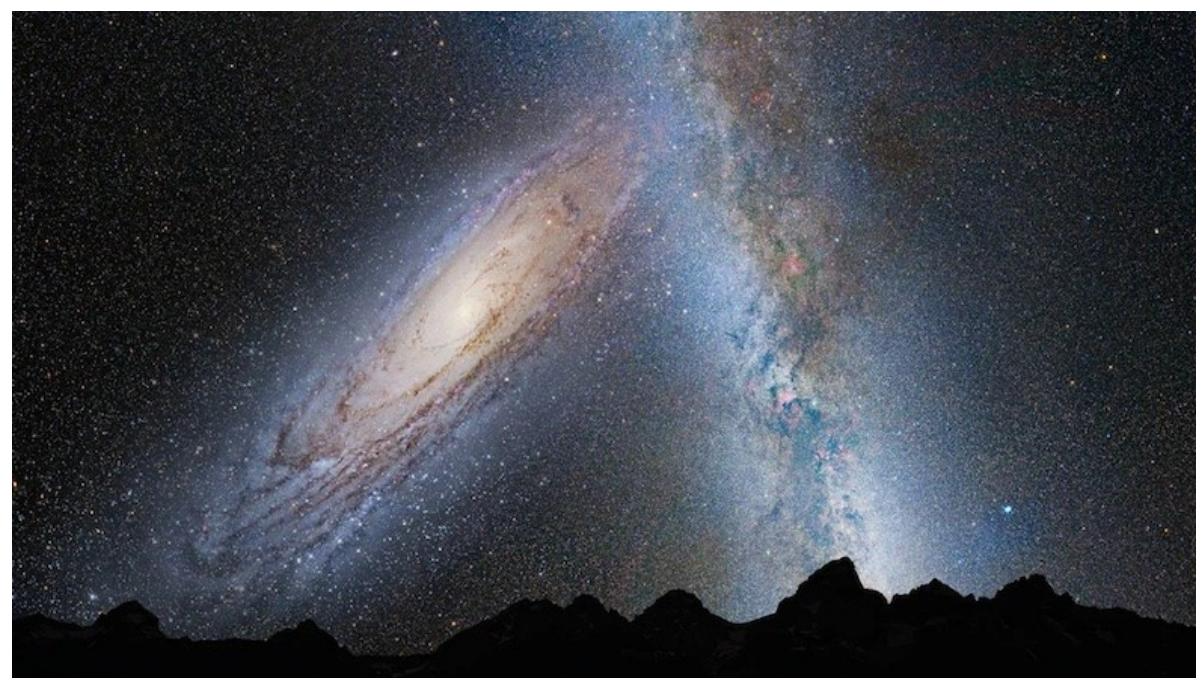
The Traditional Collision Theory: Why We Expected a Merger
For decades, the astronomical community operated under a universally accepted premise: the Milky Way and the Andromeda Galaxy (M31) were locked in a fatal gravitational embrace. This assumption was primarily based on radial velocity measurements. When astronomers observe the light emitting from Andromeda, it is significantly blueshifted. In the realm of astrophysics, a blueshift indicates that an object is moving toward the observer, contrasting with the redshift seen in galaxies expanding away from us.
Early calculations suggested that Andromeda was hurtling toward our galaxy at approximately 110 kilometers per second (68 miles per second). Given the immense mass of both galaxies and their relatively close proximity of 2.5 million light-years, a direct collision seemed unavoidable in about 4 to 5 billion years. This impending cosmic event became a staple of astronomy education, illustrating the dynamic and often violent nature of galactic evolution.
The Concept of Milkomeda
The theoretical merger birthed the concept of “Milkomeda” or “Milkdromeda,” the massive elliptical galaxy that would result from the fusion of the two spiral galaxies. Computer simulations predicted a spectacular cosmic dance where gravitational tidal forces would tear apart the spiral arms, fling stars into intergalactic space, and eventually settle the supermassive black holes at their centers into a binary system before they, too, merged. Understanding why this was the prevailing theory is crucial to appreciating the magnitude of recent discoveries that challenge it.

New Astronomical Data: Why the Milky Way and Andromeda Might Miss
The paradigm shift regarding the fate of the Milky Way and Andromeda stems from advancements in our ability to measure transverse velocity—the sideways motion of a celestial object across the sky. While radial velocity (moving toward or away) is relatively easy to measure via the Doppler effect, transverse velocity requires incredibly precise astrometry over many years. Enter the European Space Agency’s Gaia satellite and the Hubble Space Telescope.
Recent data analyses have provided the most accurate measurements of Andromeda’s proper motion to date. These findings reveal that Andromeda’s sideways velocity is much higher than previously estimated. Instead of a direct head-on collision, the current trajectory suggests the two galaxies might pass each other in a near-miss scenario. If they do interact, it may be a glancing blow rather than a catastrophic merger, fundamentally altering our timeline of the Local Group’s evolution.
Revised Mass Estimates and Dark Matter
Another critical factor in this new model is the revised mass estimates of both galaxies. The gravitational pull between the Milky Way and Andromeda is heavily dependent on their dark matter halos. Recent studies suggest that the Milky Way’s dark matter halo might be less massive than previously thought. A lower combined mass means a weaker gravitational attraction, further increasing the probability that the galaxies will simply glide past one another.
| Metric | Traditional Collision Theory | New Near-Miss Paradigm |
|---|---|---|
| Primary Motion Focus | Radial Velocity (Blueshift) | Transverse Velocity (Proper Motion) |
| Estimated Time of Interaction | 4 to 5 Billion Years | Delayed or Indefinite |
| Expected Outcome | Complete Merger into “Milkomeda” | Glancing Blow or Complete Miss |
| Dark Matter Mass Estimate | Extremely High Combined Mass | Revised Lower Mass Estimates |

The Role of the Local Group in Galactic Dynamics
To fully grasp the trajectory of Andromeda, one must look beyond the two main actors and consider the entire stage: the Local Group. The Local Group is a cluster of more than 50 galaxies, with the Milky Way and Andromeda being the largest. However, the gravitational influence of the smaller satellite galaxies cannot be ignored. They act as cosmic perturbators, subtly altering the paths of the giants over billions of years.
The Triangulum Galaxy (M33), the third-largest member of the Local Group, plays a particularly vital role. Its gravitational pull exerts a tug on Andromeda, complicating M31’s trajectory. Similarly, the Large Magellanic Cloud (LMC), currently orbiting the Milky Way, shifts the barycenter (the center of mass) of our own galaxy. When astronomers factor in these third-body perturbations, the mathematical models predicting a direct collision become highly unstable and less certain.
Technical Checklist: Variables in Galactic Tracking
Astronomers rely on a multitude of complex variables to model the future of our local universe. Here is a technical checklist of the primary factors analyzed in these simulations:
- Precise Radial Velocity (Doppler shift analysis of galactic spectra).
- High-Precision Astrometry (Transverse proper motion via Gaia and Hubble).
- Dark Matter Halo Profiling (Mass distribution and density estimates).
- Third-Body Gravitational Perturbations (Influence of the Triangulum Galaxy and LMC).
- Intergalactic Medium Drag (Friction caused by sparse gas between galaxies).
Pro Tips and Expert Advice for Stargazers
While the potential merger is billions of years away, observing Andromeda remains one of the most rewarding experiences for amateur and professional astronomers alike. As the most distant object visible to the naked eye, it offers a tangible connection to the broader cosmos and the very subject of these complex astrophysical debates.
Expert astronomers recommend observing Andromeda during the autumn months in the Northern Hemisphere, when it is highest in the sky. Because the galaxy spans an area of the sky larger than six full moons, high-magnification telescopes often zoom in too far, revealing only the bright galactic core. Instead, use wide-field binoculars (such as 10×50 or 15×70) to appreciate the full extent of its spiral arms and galactic disk.
Best Practices for Deep Sky Observation
To maximize your viewing experience, always seek out Dark Sky Preserves to eliminate light pollution. Utilize the technique of “averted vision”—looking slightly to the side of the galaxy rather than directly at it. This engages the rod cells in your eyes, which are more sensitive to the faint, diffuse light of Andromeda’s outer edges. Tracking Andromeda year after year allows you to participate in the age-old human tradition of mapping the stars, even as professional observatories redefine their ultimate fate.
Frequently Asked Questions (FAQ)
- Will the Milky Way and Andromeda ever collide?
- While it was once considered a certainty, recent data measuring Andromeda’s sideways motion (transverse velocity) and revised mass estimates suggest the two galaxies might miss each other entirely, or only experience a glancing blow rather than a full merger.
- What would happen to Earth if the galaxies did merge?
- Even in the event of a direct collision, the distances between individual stars are so vast that stellar collisions are highly unlikely. The solar system would likely survive intact, though it could be flung into a new orbit or entirely ejected into intergalactic space.
- How fast is the Andromeda galaxy moving toward us?
- Andromeda is approaching the Milky Way at a radial velocity of approximately 110 kilometers per second (about 68 miles per second). However, its sideways speed is what complicates the prediction of a direct impact.
- What is the Triangulum Galaxy’s role in this scenario?
- The Triangulum Galaxy (M33) is the third-largest galaxy in our Local Group. Its massive gravitational presence pulls on Andromeda, altering its trajectory and making a direct head-on collision with the Milky Way less likely.
- How do astronomers measure the sideways movement of a galaxy?
- Astronomers use high-precision astrometry, primarily relying on space-based observatories like the Gaia satellite and the Hubble Space Telescope, to track the microscopic shifts in the positions of Andromeda’s stars against background quasars over many years.