The Reality of Voyager’s Current Photographic Capabilities
Since crossing the heliopause and entering interstellar space, the Voyager 1 and Voyager 2 spacecraft have captured the imagination of the global public. A common question arises: can these legendary probes turn their cameras around to take new photos of the solar system from their current, unprecedented vantage points? The definitive answer is no, but the reasons behind this limitation reveal the fascinating complexities of deep space exploration.
The Imaging Science Subsystem (ISS) aboard both Voyager probes was responsible for the breathtaking images of Jupiter, Saturn, Uranus, and Neptune that defined late 20th-century astronomy. However, the mission parameters shifted dramatically once the planetary flybys concluded. To understand why we will never receive another photograph from Voyager, we must look at the strict engineering and environmental constraints dictating the survival of a spacecraft billions of miles from home.
The Pale Blue Dot: A Historical Context
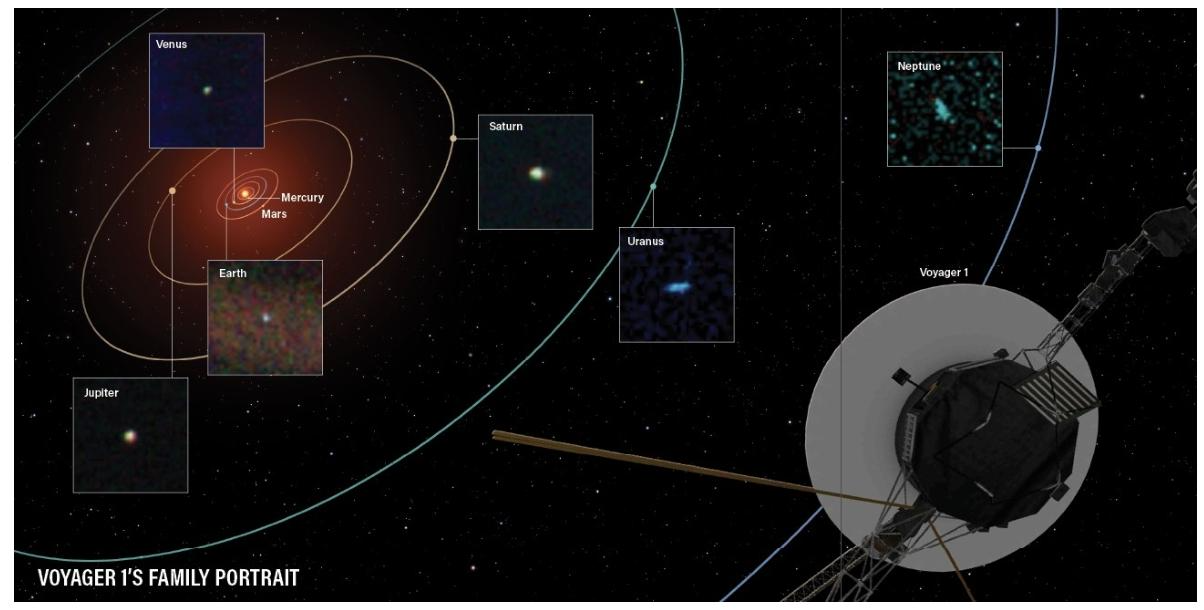
The final time Voyager 1 utilized its cameras was on February 14, 1990, to capture the famous “Family Portrait” of the solar system, which included the iconic “Pale Blue Dot” image of Earth. Conceived by astronomer Carl Sagan, this final photographic maneuver was executed just before the cameras were permanently commanded to shut down. Since that historic moment, the optical sensors have remained cold and dormant.

Why Were the Cameras Permanently Disabled?
The decision to blind the Voyager probes was not made lightly. It was a calculated survival strategy engineered by NASA to extend the lifespan of the spacecraft’s other critical scientific instruments. The primary factor driving this decision was the steady depletion of the spacecraft’s power supply.
Power Conservation and the RTG
Voyager does not rely on solar panels; at its current distance from the sun, solar energy is virtually nonexistent. Instead, the probes are powered by Radioisotope Thermoelectric Generators (RTGs), which convert the heat from decaying plutonium-238 into electricity. Because the radioactive material naturally decays, the spacecraft loses approximately 4 watts of electrical power every year. To keep vital interstellar sensors running, power-hungry systems like the cameras and their internal heaters had to be sacrificed.
Memory and Data Transmission Constraints
Even if power were not an issue, transmitting an image from interstellar space borders on the impossible. Voyager’s data transmission rate has dropped to a mere 160 bits per second. At this glacial speed, transmitting a single high-resolution photograph would take days. This massive data footprint would monopolize the Deep Space Network antennas on Earth and prevent the transmission of the continuous, vital telemetry data regarding cosmic rays and magnetic fields that scientists currently prioritize.
The Interstellar Environment
Finally, there is the issue of illumination. Voyager is currently traversing the interstellar medium, an environment characterized by near-total darkness. The sun is now just another bright star in the sky, offering no meaningful illumination to capture planetary bodies. The cameras were designed for high-speed flybys of brightly lit gas giants, not for long-exposure astrophotography in the pitch-black void of deep space.
Technical Checklist: Reactivating a Dormant Spacecraft Camera
If NASA hypothetically decided to attempt a photograph today, they would face an insurmountable sequence of technical hurdles. Here is a breakdown of what that impossible procedure would entail:
- Power Reallocation: Engineers would need to shut down current active instruments (like the Magnetometer or Cosmic Ray Subsystem) to free up enough wattage.
- Thermal Reactivation: The camera heaters, which have been off for over three decades, would need to be powered on. The extreme cold of deep space has likely warped or degraded the optical lenses and mechanical shutters beyond repair.
- Software Re-upload: The onboard computers have severely limited memory. The software required to process and compress images was deleted decades ago to make room for interstellar flight software. It would need to be rewritten and transmitted over billions of miles.
- Attitude Control Realignment: The spacecraft would need to physically turn its high-gain antenna away from Earth to point the cameras back at the solar system, risking a permanent loss of contact.
Instrument Status Comparison: Active vs. Inactive
To better understand how Voyager operates today, it is essential to compare the instruments that were sacrificed against those that are currently mapping the interstellar boundary.
| Instrument Name | Current Status | Primary Function | Reason for Status |
|---|---|---|---|
| Imaging Science Subsystem (Cameras) | Disabled (1990) | Visual photography of planets and moons | Power conservation; lack of ambient light in deep space. |
| Cosmic Ray Subsystem (CRS) | Active | Measures energetic particles in interstellar space | Crucial for understanding the heliopause boundary. |
| Magnetometer (MAG) | Active | Measures changes in the magnetic field | Requires very low power; vital for deep space mapping. |
| Infrared Interferometer Spectrometer | Disabled (1998) | Measures atmospheric compositions | Heater turned off to save RTG power. |
Expert Advice and Pro Tips on Deep Space Imaging
For astronomy enthusiasts and aspiring astrophysicists, understanding the limitations of legacy spacecraft provides profound insight into modern mission design. Here are expert takeaways regarding deep space telemetry:
Pro Tip 1: Think Beyond the Visual Spectrum. Visual photography is only a tiny fraction of space exploration. The most groundbreaking discoveries from Voyager today come from non-visual data, such as plasma wave vibrations and magnetic field shifts. Learning to interpret graphical data is just as important as analyzing a photograph.
Pro Tip 2: Understand the Inverse-Square Law. When designing theoretical deep-space missions, remember that light and radio signal strength degrade exponentially over distance. Modern missions like the James Webb Space Telescope bypass this by remaining relatively close to Earth while using massive mirrors, rather than traveling to the objects they wish to photograph.
Frequently Asked Questions (FAQ)
- Can NASA turn Voyager’s cameras back on?
- No. The software required to operate the cameras was deleted from the spacecraft’s memory decades ago to make room for new data. Furthermore, the spacecraft lacks the electrical power to run the cameras and their necessary internal heaters.
- What was the last picture taken by Voyager 1?
- The last photograph taken by Voyager 1 was the famous “Pale Blue Dot” on February 14, 1990. It was part of a larger mosaic of 60 frames known as the “Family Portrait,” capturing several planets in our solar system from beyond the orbit of Neptune.
- How dark is it where Voyager is currently located?
- Voyager is in interstellar space, billions of miles from the sun. The ambient light is virtually nonexistent. If the cameras were turned on, they would only capture the faint light of distant stars, as there are no brightly illuminated bodies nearby to photograph.
- How does Voyager send data back to Earth without cameras?
- Voyager transmits telemetry data using its high-gain antenna, communicating with NASA’s Deep Space Network. It sends binary data regarding magnetic fields, plasma density, and cosmic rays, which scientists on Earth then decode and analyze.
- Will Voyager ever take another picture?
- No. The imaging mission of the Voyager probes is permanently concluded. The spacecraft will continue to transmit non-visual scientific data until its radioactive power source depletes entirely, which is expected to occur in the late 2020s or early 2030s.