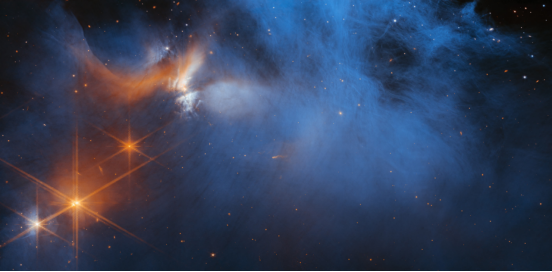
The fundamental question of how life began on Earth is one of humanity’s most enduring mysteries. For centuries, we looked for answers within our own planet’s primordial soup. However, modern astronomy and astrobiology are increasingly pointing to the stars, suggesting that the essential ingredients for life were not forged on Earth, but in the vast, cold expanses of interstellar space. This journey begins in gigantic cosmic nurseries known as interstellar molecular clouds and culminates in a celestial delivery service performed by comets and asteroids. This guide explores the incredible cosmic chemistry that creates pre-life molecules and the mechanisms that brought them to our world.
Understanding this process is crucial, as it reframes our perspective on life in the universe. If the building blocks of life are common throughout the cosmos, it dramatically increases the possibility that life itself could arise on other worlds. We will delve into the types of molecules being discovered, the environments that create them, and the evidence supporting their interplanetary transport, painting a picture of a universe ripe with the potential for biology.
What Are Interstellar Molecular Clouds? The Cosmic Chemical Factories
Long before stars and planets exist, their raw materials gather in enormous, cold, and dark structures known as Interstellar Molecular Clouds (IMCs). These are not empty voids but vast collections of gas (primarily hydrogen and helium) and dust, stretching across dozens or even hundreds of light-years. They are the birthplaces of stars, but they are also incredibly sophisticated chemical laboratories where the first steps towards life are taken.
Defining the Environment for Prebiotic Chemistry
The conditions within an IMC are extreme and seemingly inhospitable. Temperatures can plummet to just 10 to 20 Kelvin (-263 to -253 degrees Celsius), a mere fraction above absolute zero. At these temperatures, atoms and molecules move very slowly. The clouds are also incredibly dense by interstellar standards, which allows molecules to collide and react. This combination of low temperature and high density is the perfect setting for a unique type of chemistry to unfold on the surfaces of tiny dust grains.
The Crucial Role of Icy Dust Grains
Scattered throughout the gas in IMCs are microscopic dust grains, typically composed of silicates and carbon. In the frigid environment, gas molecules that collide with these grains freeze onto their surfaces, forming thick mantles of ice. This isn’t just water ice; it includes frozen carbon monoxide, carbon dioxide, methane, and ammonia. These icy surfaces act as catalytic meeting points. Atoms and simple molecules can stick to the ice, migrate across the surface, and encounter other reactants, allowing for the formation of much more complex structures that would be impossible in the sparse gas phase alone. This process is known as grain-surface chemistry, and it is the primary engine for building the precursors to life.

Unveiling the Precursors to Life: Complex Organic Molecules in Space
Through the power of radio astronomy, scientists can peer into these dark clouds and detect the unique spectral “fingerprints” of different molecules. What they have found is a stunningly rich and complex chemical inventory. The term Complex Organic Molecules (COMs) in astrochemistry refers to any carbon-based molecule with six or more atoms. The discovery of numerous COMs in IMCs confirms that the universe is actively manufacturing the raw materials for biology long before planets even form.
A Catalog of Cosmic Ingredients
The list of detected COMs is constantly growing and includes many molecules that are direct precursors to key biological structures. These are not yet amino acids or DNA, but they are the fundamental building blocks from which those larger structures can be assembled.
- Formamide (NH2CHO): A crucial molecule because it contains four essential elements (nitrogen, hydrogen, carbon, oxygen) and can serve as a starting point for synthesizing amino acids, nucleic acids, and other vital compounds.
- Acetaldehyde (CH3CHO): Plays a role in the formation of sugars, including ribose, the sugar that forms the backbone of RNA.
- Methyl Isocyanate (CH3NCO): A precursor for peptides, which are short chains of amino acids.
- Methanol (CH3OH): The most abundant complex organic molecule found in space, acting as a foundational ingredient for more complex chemistry.
- Glycolaldehyde (CH2OHCHO): A simple sugar molecule, demonstrating that the basic components of carbohydrates exist in interstellar space.
Formation Pathways: Gas-Phase vs. Grain-Surface Reactions
The creation of these molecules follows two main pathways. Gas-phase chemistry involves reactions between ions and molecules in the sparse gas of the cloud. However, this process is generally limited to producing smaller, simpler molecules. The real powerhouse for creating COMs is the aforementioned grain-surface chemistry. The icy mantles on dust grains not only concentrate reactants but also absorb energy from nearby starlight (UV radiation), which can trigger chemical reactions and break bonds, allowing more complex molecules to form. Eventually, as a nearby star ignites, its heat can sublimate these icy mantles, releasing the newly formed complex molecules back into the gas phase where they can be detected by telescopes.

Interstellar Icy Bodies: The Ultimate Delivery System
Creating the building blocks of life in a distant molecular cloud is only the first step. For them to be useful, they must be transported to a newly forming planet. This is where interstellar icy bodies—comets and asteroids—play their vital role. As a molecular cloud collapses to form a new star and a surrounding protoplanetary disk, the dust grains, now coated with rich organic material, are incorporated into larger bodies. These bodies become the comets and asteroids of the new solar system, effectively acting as frozen time capsules, preserving the complex organic chemistry from the parent cloud.
The Panspermia Hypothesis: A Cosmic Seeding
The idea that life’s ingredients were delivered from space is a concept known as Panspermia (or more specifically, “molecular panspermia” or “exogenesis”). This hypothesis posits that comets and asteroids, bombarding a young, sterile Earth, delivered two essential components: water and complex organic molecules. This celestial bombardment, particularly during a period known as the Late Heavy Bombardment around 4 billion years ago, could have seeded Earth’s oceans with the exact raw materials needed for the first life to emerge.
Evidence from Our Solar System
This is not just a theoretical concept; we have direct evidence from multiple sources:
- Meteorite Analysis: The famous Murchison meteorite, which fell in Australia in 1969, was found to contain over 100 different amino acids, the building blocks of proteins. Crucially, these amino acids existed in both left-handed and right-handed forms, a signature of non-biological origin, proving they were formed in space.
- Cometary Missions: The European Space Agency’s Rosetta mission to Comet 67P/Churyumov-Gerasimenko detected a wealth of organic molecules, including the amino acid glycine and phosphorus, a key component of DNA and cell membranes.
- Asteroid Sample Return: JAXA’s Hayabusa2 mission returned samples from the asteroid Ryugu which were found to contain uracil (a nucleobase of RNA) and niacin (Vitamin B3), further confirming that asteroids carry complex, life-critical molecules.

From Stardust to Biology: The Journey to a Habitable Planet
The complete journey from stardust to living organism is a story of cosmic recycling and planetary evolution. The organic molecules synthesized in an interstellar cloud are first incorporated into a protoplanetary disk. Within this disk, they become part of the asteroids and comets that will eventually shape the planets. For a planet like Earth, located in the habitable zone, this delivery system was a game-changer.
The Late Heavy Bombardment and Earth’s Primordial Soup
During the early history of the solar system, impacts were far more frequent. The Late Heavy Bombardment was an intense period of comet and asteroid collisions with the inner planets. While destructive, this era was also constructive. Each impact delivered tons of water and a rich slurry of organic compounds to Earth’s surface. This constant influx of extraterrestrial material enriched the planet’s oceans, creating a chemically complex “primordial soup” that contained all the necessary ingredients for abiogenesis—the process by which life arises from non-living matter.
Implications for Life Beyond Earth
The discovery that the building blocks of life are not unique to Earth but are instead common byproducts of star and planet formation has profound implications for astrobiology. It suggests that any planet forming in any star system has a high probability of being seeded with the same prebiotic molecules that Earth received. While this does not guarantee that life will emerge, it means the fundamental raw materials are universally available. The search for extraterrestrial life, therefore, becomes a search for worlds where these delivered ingredients found the right conditions—such as liquid water and a stable energy source—to assemble into living systems.
Frequently Asked Questions (FAQ)
- What is the most complex organic molecule found in space so far?
- While the list is always growing, some of the most complex molecules detected include polycyclic aromatic hydrocarbons (PAHs), which are large, complex structures of carbon and hydrogen. In terms of prebiotic potential, the discovery of multiple amino acids, nucleobases like uracil, and complex sugars in meteorites and cometary samples represents some of the most biologically significant findings.
- How do scientists detect these molecules millions of light-years away?
- Scientists primarily use radio astronomy. Every molecule rotates and vibrates at specific, unique frequencies. When they do, they emit or absorb radiation at these frequencies, creating a spectral “fingerprint.” Powerful radio telescopes, like the Atacama Large Millimeter/submillimeter Array (ALMA), can detect these faint signals coming from interstellar clouds, allowing astronomers to identify the chemical composition of the gas from vast distances.
- Could life itself, not just its building blocks, travel between stars?
- This is the theory of Lithopanspermia, which suggests that hardy microorganisms (like extremophiles) could be transported inside rocks ejected from a planet by a major impact. While theoretically possible, the challenges are immense, including surviving the initial impact, the vacuum of space, intense radiation over millions of years, and the fiery entry into a new atmosphere. Currently, the delivery of life’s building blocks (molecular panspermia) is a much more widely supported and evidenced hypothesis than the delivery of actual living organisms.
- Does the presence of these molecules mean life is common in the universe?
- Not necessarily, but it significantly increases the probability. It means the raw materials for life are ubiquitous. The major remaining questions are about the next steps: how do these building blocks assemble into self-replicating systems (abiogenesis), and how often do planets provide the stable, long-term conditions (liquid water, moderate temperatures, energy source) for this process to occur? The commonality of ingredients is a very encouraging first step.
- What is the difference between an interstellar molecular cloud and a nebula?
- The terms are often used interchangeably, but there are technical differences. “Nebula” is a general term for any diffuse cloud of gas and dust in space. This includes star-forming regions, the remnants of dead stars (planetary nebulae), and supernova remnants. An “interstellar molecular cloud” is a specific type of nebula that is particularly cold and dense, where the gas is primarily in molecular form (like H2) rather than atomic form. Molecular clouds are the primary sites of star formation and complex chemistry.