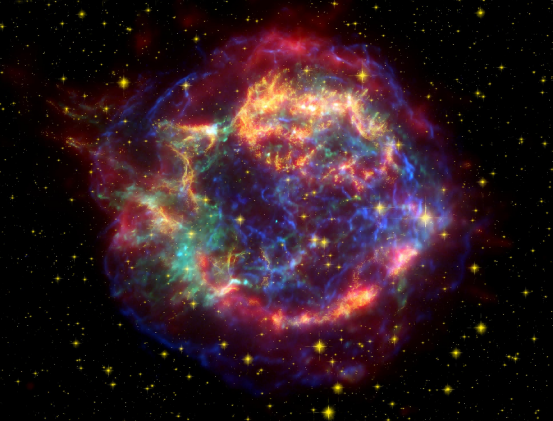
The universe is not a static void but a dynamic, self-sustaining factory of matter and energy. At the heart of this grand design is the stellar life cycle—a continuous loop of creation and destruction. This process begins in the cold, dense molecular clouds of nebulae, reaches its zenith in the fusion cores of massive stars, and concludes in cataclysmic explosions that seed the cosmos with the ingredients for future worlds. By understanding the relationship between star-forming regions like the Pillars of Creation and the skeletal remains of dead stars known as supernova remnants, we gain insight into our own origins as “stardust.”
The Pillars of Creation: Cradles of the Universe
The Pillars of Creation, located within the Eagle Nebula (M16) approximately 6,500 light-years from Earth, represent the most iconic manifestation of stellar birth. These towering structures of interstellar gas and dust are essentially “elephant trunks” of molecular hydrogen. They serve as the primary nurseries where gravity overcomes internal pressure to collapse pockets of gas into protostars.
The Anatomy of the Pillars
The pillars are composed of cool molecular hydrogen and dust, which act as a shield against the intense ultraviolet radiation from nearby hot, young stars. This process, known as photo-evaporation, is a double-edged sword. While the radiation erodes the pillars, it also compresses the gas at the edges, triggering the formation of new stars. The tallest pillar is roughly four light-years long, illustrating the immense scale of these cosmic structures.
The Birth of Protostars
Inside the dense tips of the pillars, astronomers have identified “Evaporating Gaseous Globules” (EGGs). These are regions where the gas is so dense that it can withstand the external radiation long enough for gravity to pull the material together. Once the core reaches a critical temperature and pressure, nuclear fusion ignites, and a star is born. This transition from a dark cloud to a luminous star marks the first phase of the cosmic cycle.
- Density Dynamics: The pillars are significantly denser than the surrounding space, allowing them to survive the “stellar winds” of nearby O-type stars.
- Infrared Observation: While visible light shows the dust, infrared light (as seen by the James Webb Space Telescope) allows us to peer through the shroud to see the glowing protostars within.

Supernova Remnants: The Brilliant Tombstones of Dead Stars
If the Pillars of Creation are the nurseries, supernova remnants (SNRs) are the workshops of the universe’s later stages. When a massive star exhausts its nuclear fuel, it undergoes a gravitational collapse followed by a massive explosion. What remains is a beautiful, expanding shell of gas and heavy elements that enriches the interstellar medium.
The Mechanism of Dispersion
The explosion of a supernova releases an incredible amount of energy, ejecting the star’s outer layers at speeds reaching 10% of the speed of light. These shockwaves collide with the surrounding interstellar gas, heating it to millions of degrees and causing it to glow across the electromagnetic spectrum, from X-rays to radio waves. These remnants, such as the Crab Nebula or Cassiopeia A, are not merely “tombstones”; they are active sites of chemical enrichment.
Shockwaves and the Interstellar Medium
The interaction between the SNR and the interstellar medium (ISM) is crucial for the next generation of stars. The shockwaves compress nearby clouds of gas, which can trigger the collapse of new nebulae—effectively starting the process seen in the Pillars of Creation. This feedback loop ensures that the death of one star directly contributes to the birth of others.

Cosmic Alchemy: The Origin of Heavy Elements
The universe began with only hydrogen, helium, and trace amounts of lithium. Every other element, including the carbon in our DNA and the gold in our jewelry, was forged inside stars or during their violent deaths. This process is known as nucleosynthesis.
Stellar Fusion: The Light Elements
During a star’s main sequence, it fuses hydrogen into helium. As it ages and becomes a red giant, it begins fusing heavier elements: helium into carbon, carbon into neon, and so on, up to iron. Iron represents a thermodynamic dead end; fusing iron consumes more energy than it releases, leading to the star’s eventual collapse.
| Element Group | Source of Creation | Common Examples |
|---|---|---|
| Light Elements | Big Bang / Main Sequence Fusion | Hydrogen, Helium |
| Intermediate Elements | Red Giant Fusion | Carbon, Oxygen, Magnesium |
| Heavy Elements | Supernovae / Neutron Star Mergers | Gold, Platinum, Uranium |
The R-Process and S-Process
Elements heavier than iron require extreme environments to form. The s-process (slow neutron capture) occurs in pulsating red giants, while the r-process (rapid neutron capture) occurs during the violent environment of a supernova or a neutron star merger. In these moments, nuclei are bombarded with neutrons so quickly that they transform into heavy, stable elements before they can decay.

The Elemental Cycle: From Stardust to Planets and Life
The heavy elements synthesized in supernovae do not stay confined to the explosion site. They are propelled across the galaxy, eventually settling into the “galactic recycling bin”—the interstellar medium. Over billions of years, this medium becomes increasingly enriched with metals (in astronomy, “metals” refers to any element heavier than helium).
Enrichment of the Galactic Ecosystem
When a new generation of stars forms from an enriched cloud, they are accompanied by protoplanetary disks. These disks contain the dust and heavy elements necessary to form terrestrial planets like Earth. Without the “alchemy” performed by previous generations of dying stars, the universe would consist only of gas giants and stars, with no solid ground for life to take hold.
The Biological Connection
The calcium in our bones, the iron in our blood, and the oxygen we breathe are all products of this cosmic cycle. We are, quite literally, the remnants of ancient stars that exploded billions of years ago. This realization bridges the gap between astrophysics and biology, showing that the history of the universe is also our own history.

Technological Frontiers in Mapping the Cosmos
Our understanding of these processes has been revolutionized by advanced observational technology. By looking at different wavelengths of light, we can see different stages of the stellar life cycle that were previously hidden.
Hubble vs. James Webb Space Telescope
The Hubble Space Telescope provided the first high-resolution visible-light images of the Pillars of Creation, showcasing their majestic beauty. However, the James Webb Space Telescope (JWST), with its infrared capabilities, has allowed us to see *through* the dust. JWST has revealed thousands of young stars inside the pillars, providing a much more detailed map of how star formation occurs in real-time.
X-Ray Astronomy and Supernovae
Observatories like the Chandra X-ray Observatory are essential for studying supernova remnants. X-rays reveal the high-energy shockwaves and the distribution of heavy elements within the expanding shell. By mapping the location of elements like silicon, sulfur, and iron in a remnant, scientists can reconstruct the exact physics of the original explosion.

The Future of Stellar Evolution Studies
As we move forward, the focus of stellar research is shifting toward “multi-messenger astronomy.” This involves combining data from light (electromagnetic radiation), gravitational waves, and neutrinos to get a complete picture of cosmic events. For instance, the detection of gravitational waves from merging neutron stars has confirmed that these events are a major source of the universe’s gold and silver.
The Role of Artificial Intelligence
With the massive influx of data from telescopes like the Vera C. Rubin Observatory, astronomers are using AI and machine learning to identify and categorize supernova remnants and star-forming regions. This allows for a more comprehensive census of the galaxy’s elemental production rate, helping us refine our models of galactic evolution.

Conclusion: The Eternal Recurrence of the Universe
The journey from the Pillars of Creation to the heavy elements forged in supernovae is a testament to the universe’s complexity. Every star that dies provides the seeds for a new beginning, ensuring that the cosmos remains a place of constant transformation. As we look up at the night sky, we are not just looking at distant lights; we are looking at the engines of creation that made our existence possible. The study of these cosmic workshops—both the nurseries and the graveyards—continues to be one of the most profound endeavors in human science.
Frequently Asked Questions (FAQ)
- Q1: Why are the Pillars of Creation called “Pillars”?
- They are named for their column-like appearance, which is formed by the erosion of gas and dust clouds by the ultraviolet light from nearby massive stars. These “pillars” are actually light-years long and contain enough material to form thousands of new stars.
- Q2: How do supernovae create gold and other precious metals?
- Precious metals are created through the r-process (rapid neutron capture). During the extreme conditions of a supernova explosion or a neutron star merger, atomic nuclei are bombarded with neutrons so quickly that they transform into heavier elements like gold and platinum before they can decay.
- Q3: Will our Sun ever become a supernova?
- No. Our Sun is not massive enough to end its life in a supernova. Instead, it will eventually become a red giant and then shed its outer layers to form a planetary nebula, leaving behind a white dwarf. Only stars at least 8 to 10 times the mass of our Sun become supernovae.
- Q4: What is the difference between a nebula and a supernova remnant?
- A nebula is a general term for any cloud of gas and dust in space. While a supernova remnant is a *type* of nebula, it specifically refers to the material left over after a star has exploded. Other nebulae, like the Pillars of Creation, are regions where stars are being born rather than where they have died.
- Q5: Can we see the Pillars of Creation with a backyard telescope?
- The Eagle Nebula (which contains the pillars) can be seen with a good amateur telescope under dark skies, but the specific “Pillars” detail usually requires long-exposure photography and high-quality equipment to distinguish from the surrounding glow.