
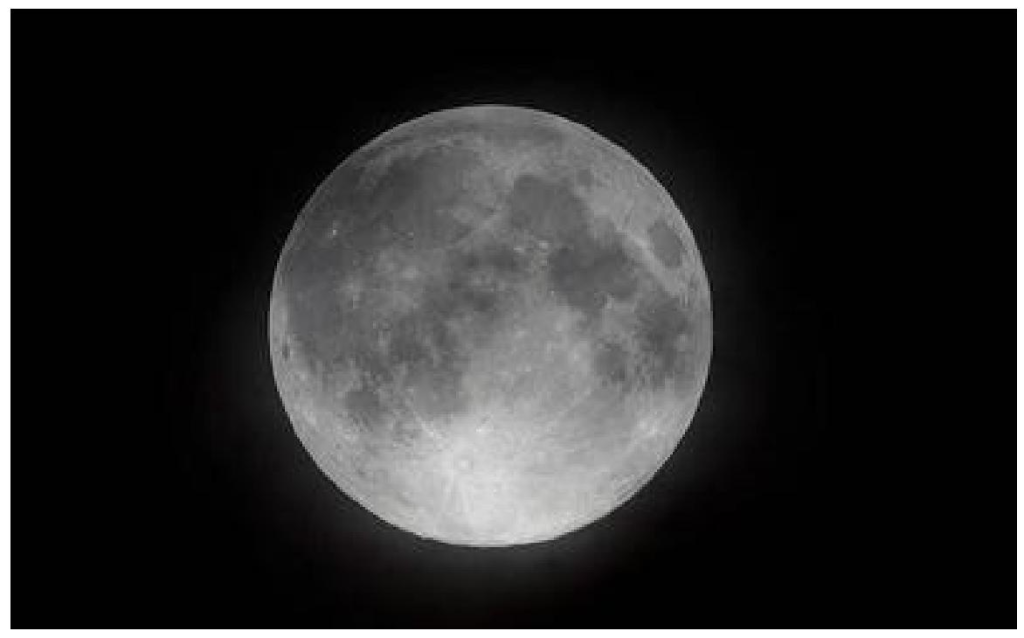
The “heart shape” on the Moon is formed by the interplay of light and shadow, visible once a month before the first quarter moon.
This unique topographical feature lies near the Apollo 15 landing site on the lunar surface, roughly between the Archimedes crater and Hadley Rille (also known as Rima Hadley). It is so close to the landing site that astronauts David Scott and James Irwin could clearly see it during their mission and even waved toward it. When observing the Moon through a telescope from Earth, this “heart” can be imagined as a monument to humanity’s passion for lunar exploration, symbolizing our desire to explore the unknown.
I stumbled upon the “heart shape” on the night of July 13, 2024—just shy of the 53rd anniversary of Apollo 15’s lunar landing on July 30, 1971. On a whim, I took out my 3-inch Tele Vue refracting telescope and began scanning the Moon’s terminator (the curved line separating the illuminated and shadowed portions) at 225x magnification. Suddenly, this beautiful sight came into view, taking my breath away. At the time of observation, the Moon was 48% illuminated, 7 days and 19 hours after the new moon, positioned at longitude 359 degrees.
The lunar heart almost entirely covers Palus Putredinis, also less poetically known as the “Marsh of Decay,” stretching approximately 110 miles (180 kilometers) east to west. It is surrounded by several lunar features: the Archimedes crater to the west, the Hadley-Apennine Mountains to the east, a highland plateau near the Otto Struve crater to the north, and a U-shaped highland ridge west of the southern end of Hadley Rille.

The Palus Putredinis region itself is quite fascinating. For example, the northwest lobe of the “heart” is not formed by lunar peaks but by a series of braided folded ridges—structures created by tectonic folding, uplift, or compression. At the northern end of these ridges, you will find the crescent-shaped small crater Spurr, whose ghostly northern rim is almost completely submerged by ancient lava flows. In addition to Hadley Rille, several other volcanic rille systems (likely lava channels) can be found south of the “heart,” such as Rima Bradley, which runs through the region.
On September 13, 1959, the Soviet Union’s Luna 2 probe successfully impacted the lunar surface, making it the first spacecraft in human history to make direct contact with another celestial body. This impact occurred in the northern lobe region, specifically southwest of the Otto Struve crater. This historic event not only marked a significant milestone in humanity’s exploration of outer space but also accumulated valuable experience and data for subsequent lunar missions.
Twelve years later, in 1971, NASA’s Apollo 15 mission once again turned humanity’s attention to the Moon. This mission not only successfully sent astronauts to the lunar surface but also landed approximately 160 miles (about 260 kilometers) from the crash site of the Luna 2 probe. The Apollo 15 landing site is located in the Hadley-Apennine Mountains region, considered one of the most geologically complex areas on the Moon. Through this mission, astronauts brought back a large number of lunar rock and soil samples and took many high-resolution photographs of the lunar surface, providing scientists with more clues about the Moon’s geology and origin. The successful landing of Apollo 15 further advanced humanity’s exploration of the Moon and the entire solar system.