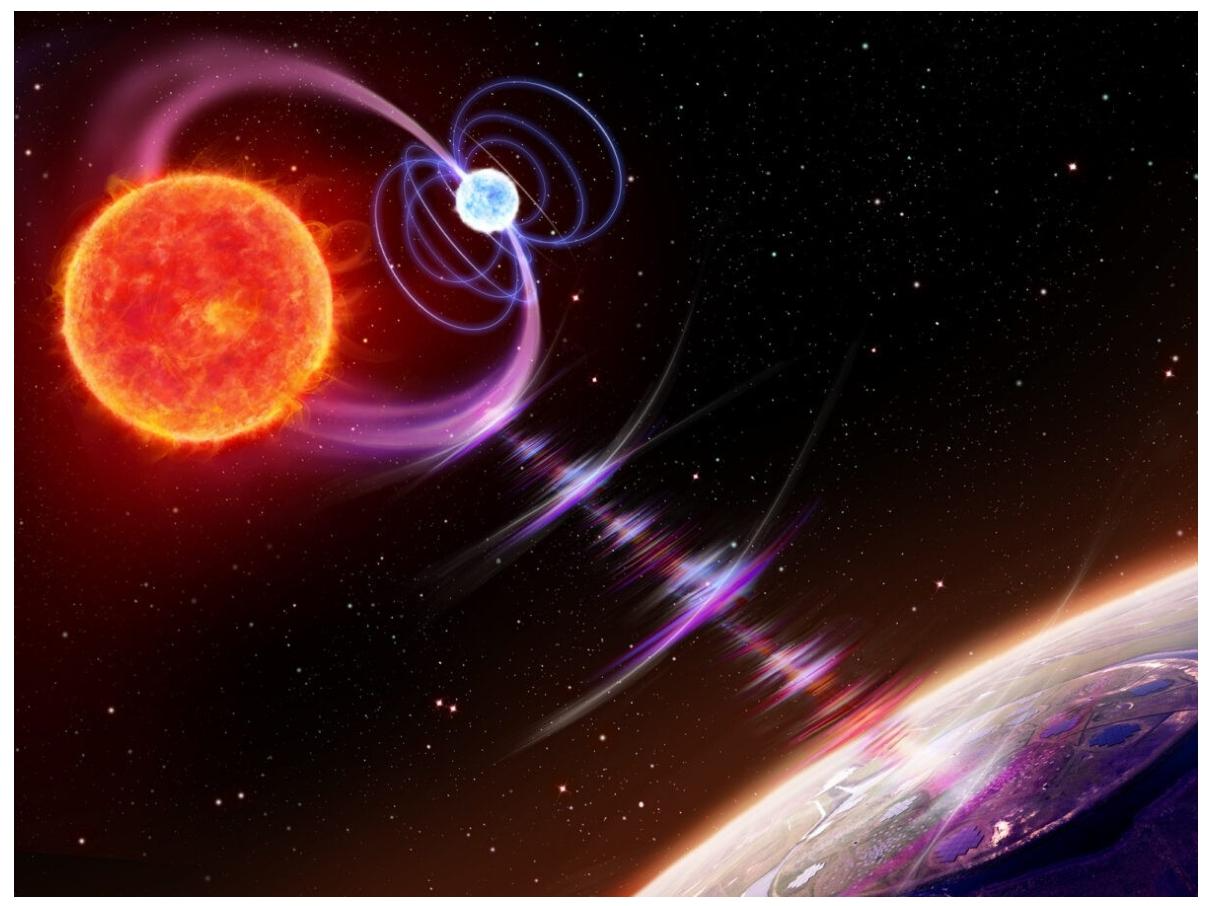
The universe is a vast expanse filled with celestial objects that continuously challenge our understanding of physics. Among the most enigmatic of these are pulsars, the rapidly spinning remnants of massive stars. For decades, astronomers believed they had a solid grasp on how these cosmic lighthouses behave. However, a recent wave of discoveries has unveiled a new class of anomalous objects—dead stars and strange pulsars that emit radio signals in ways previously thought impossible. These findings are not just curiosities; they are forcing a fundamental re-evaluation of stellar evolution and the extreme physics that govern the cosmos.
This guide delves into these groundbreaking discoveries, exploring the bizarre behaviors of newly identified pulsars. We will examine a dead star that sends signals on an impossibly long timescale, a slow-motion pulsar that flickers in and out of existence, and a unique binary system where a pulsar dances with a stripped-down helium star. These case studies, powered by advanced radio telescopes, are opening a new window into the life and death of stars.
What Are Pulsars? Unveiling the Cosmic Lighthouses
Before exploring the anomalies, it’s crucial to understand what a standard pulsar is. A pulsar is a type of neutron star, which is the incredibly dense core left behind after a massive star explodes in a supernova. While a neutron star can have a mass greater than our sun, it is compressed into a sphere only about 20 kilometers in diameter. This extreme density gives them incredibly powerful gravitational and magnetic fields.
What makes a neutron star a pulsar is its rapid rotation combined with its intense magnetic field. This magnetic field funnels charged particles, generating powerful beams of electromagnetic radiation that emanate from its magnetic poles. As the neutron star spins, these beams sweep across space much like the beam of a lighthouse. If one of these beams happens to sweep across Earth, our radio telescopes detect a regular, repeating pulse of energy. This is why they are called “pulsars”—for their pulsating radio signals. Most known pulsars rotate hundreds of times per second, but these new discoveries are found at the extreme slow end of the spectrum.

The Enigma of ASKAP J1935+2148: A Dead Star’s Ghostly Signal
One of the most perplexing recent discoveries is an object designated ASKAP J1935+2148, detected by the powerful ASKAP radio telescope in Western Australia. This object is sending out regular radio signals, but with a periodicity that shatters existing theories. It is a celestial body that, by all conventional models, should be silent.
An Unprecedented 53-Minute Periodicity
The defining feature of ASKAP J1935+2148 is its astonishingly long rotation period of 53.8 minutes. This is thousands of times slower than a typical pulsar. According to established astrophysical models, pulsars slow down over time as they radiate energy. Eventually, they cross a theoretical boundary known as the “death line,” where their rotation and magnetic field are no longer strong enough to generate radio emissions. ASKAP J1935+2148 is located deep within this “neutron star graveyard,” yet it is clearly and powerfully active, broadcasting signals across the cosmos.
Three Distinct and Baffling Emission States
Adding to the mystery, the signal from this object is not uniform. Astronomers have observed it switching between three completely different states, a behavior never seen before in a single pulsar.
- Bright, Linearly Polarized Pulses: The object emits exceptionally bright pulses that last between 10 and 50 seconds. These emissions are highly organized, with light waves oscillating in a single plane.
- Weaker, Circularly Polarized Pulses: At other times, the object produces pulses that are about 26 times weaker and have a circular polarization, meaning the light waves spiral as they travel. These pulses are much shorter, lasting only around 370 milliseconds.
- Quiescent or “Off” State: Most remarkably, the object also enters periods of complete silence, where no pulses are detected at all. This complex, multi-state behavior suggests an emission mechanism that is far more complicated than anything currently understood.
A Neutron Star or a White Dwarf?
The nature of ASKAP J1935+2148 is a subject of intense debate. The two leading theories are that it is either an ultra-long-period magnetar—a type of neutron star with an exceptionally powerful magnetic field—or a highly magnetized white dwarf, the remnant of a smaller, sun-like star. If it is a neutron star, its existence challenges our understanding of the death line. If it’s a white dwarf, it would be the first of its kind ever detected emitting such powerful, coherent radio pulses, opening up an entirely new field of study.

PSR J0901-4046: The Flickering Giant in the Tarantula Nebula
Another strange object pushing the boundaries of pulsar physics is PSR J0901-4046, discovered using the MeerKAT radio telescope in South Africa. Located in the tumultuous Tarantula Nebula, a star-forming region in a neighboring galaxy, this pulsar exhibits a unique combination of extreme slowness and an intermittent, “flickering” emission pattern.
An Ultra-Long Rotation Period
With a rotation period of 76 seconds, PSR J0901-4046 was one of the longest-period pulsars ever found at the time of its discovery. Like ASKAP J1935+2148, its slow spin places it near the pulsar death line, making its powerful radio emissions a significant puzzle for astrophysicists. The existence of multiple, distinct, ultra-slow pulsars suggests that our models of how and when pulsars cease their emissions are incomplete.
The Phenomenon of Pulsar Nulling
What makes PSR J0901-4046 particularly strange is its pronounced “flickering” behavior, a phenomenon known as pulsar nulling. This means the pulsar switches off its radio beams for extended periods before suddenly turning back on. While nulling has been observed in other pulsars, it is typically seen in faster-spinning objects. The combination of its extreme slowness and intermittent nulling in PSR J0901-4046 presents a unique challenge to the standard model of how radio waves are generated in a pulsar’s magnetosphere. This behavior suggests that the physical processes in the magnetospheres of slow-spinning neutron stars may be fundamentally different from their faster cousins.

A Cosmic Dance: The Pulsar and Helium Star Binary System
Not all pulsar mysteries involve solitary objects. The discovery of PSR J1125-5816 provides a fascinating look into the complex lives of pulsars in binary systems. This system consists of a pulsar locked in a tight orbit with a hot, low-mass helium star, offering a perfect laboratory for studying stellar evolution in close quarters.
The Nature of the Helium Star Companion
The companion to PSR J1125-5816 is the exposed core of a star that has been fundamentally altered by the pulsar. In its past, the companion was a much larger star. As the pulsar’s powerful gravitational pull and radiation bombarded it, its outer layers of hydrogen were stripped away, leaving only a dense, hot core composed primarily of helium. This process is a key stage in the evolution of many binary systems and provides direct evidence of the dramatic influence a pulsar can have on its neighbors.
Insights into Binary Evolution and “Spider” Pulsars
This system provides crucial insights into how some of the most extreme binary systems in the universe form. The pulsar in this system is likely a “recycled” pulsar. It was once an older, slower pulsar that was spun up to faster speeds by accreting matter from its companion star. This process of “recycling” is fundamental to our understanding of millisecond pulsars. Furthermore, PSR J1125-5816 is seen as a progenitor to even more extreme systems known as “spider” pulsars, where the pulsar is actively consuming its companion star. By studying this system, astronomers can piece together the complete evolutionary timeline of these cosmic cannibals.

The Significance of These Anomalous Pulsar Discoveries
The discoveries of ASKAP J1935+2148, PSR J0901-4046, and PSR J1125-5816 are more than just astronomical novelties. They represent a paradigm shift in our understanding of compact stellar objects. Each one challenges long-held theories and opens up new avenues for research, highlighting how much we still have to learn about the universe.
Pushing the Boundaries of Extreme Physics
These objects exist at the very edge of what is physically possible. The immense gravity, density, and magnetic fields of neutron stars create conditions that cannot be replicated on Earth. By studying how these anomalous pulsars generate radio emissions despite their slow speeds or complex environments, scientists can test the limits of fundamental physics and refine their models of plasma behavior under extreme conditions.
Refining Models of Stellar Evolution
The existence of ultra-long-period pulsars forces a rewrite of the “pulsar death line” concept, suggesting that magnetic fields or emission mechanisms may persist in ways we never anticipated. Likewise, binary systems like PSR J1125-5816 provide a real-world snapshot of theoretical evolutionary pathways, confirming our models of mass transfer, stellar stripping, and the formation of exotic objects. These discoveries are filling in critical gaps in the story of how stars live, die, and interact with each other.
The Role of Advanced Telescopes
It is no coincidence that these discoveries are happening now. They are a direct result of the unprecedented sensitivity and wide fields of view of new-generation radio telescopes like ASKAP in Australia and MeerKAT in South Africa. These instruments can survey vast patches of the sky with incredible detail, allowing them to detect faint, intermittent, or unusual signals that were previously missed. As these observatories continue their work, we can expect the catalog of anomalous pulsars to grow, bringing even more cosmic mysteries to light.
Frequently Asked Questions (FAQ)
- What is the “neutron star graveyard”?
- The “neutron star graveyard” is a theoretical region in a diagram plotting a pulsar’s rotation period against its magnetic field strength. In this region, pulsars are predicted to be too old and slow, with magnetic fields too weak, to generate detectable radio emissions. The discovery of ASKAP J1935+2148 actively emitting from this region challenges the very existence or location of this “death line.”
- Why is a 53-minute rotation period for a pulsar so unusual?
- Most known pulsars spin incredibly fast, from several times per second to hundreds of times per second. A rotation period of 53.8 minutes is exceptionally slow, thousands of times slower than a typical pulsar. This slowness implies the object is either extremely old or formed with unusual properties, and conventional physics suggests it should not have enough rotational energy to power radio emissions.
- What is a “recycled” pulsar?
- A “recycled” pulsar is an old, slow-spinning neutron star in a binary system that has been spun up to high speeds. This happens when it pulls, or accretes, matter from its companion star. The infalling matter transfers angular momentum to the neutron star, “recycling” it into a rapidly spinning millisecond pulsar. The system PSR J1125-5816 is a prime example of a system undergoing this process.
- How do telescopes like ASKAP and MeerKAT find these strange objects?
- These next-generation radio telescopes have two key advantages: immense sensitivity to detect very faint signals, and a very wide field of view, allowing them to survey large areas of the sky quickly. This combination is perfect for finding transient or unusual objects like ultra-long-period pulsars, which might only emit signals intermittently or from unexpected regions of space.
- Could ASKAP J1935+2148 be something other than a neutron star?
- Yes, that is one of the leading possibilities. Some astronomers theorize it could be a highly magnetized white dwarf. White dwarfs are the remnants of smaller stars and are not typically expected to produce powerful, coherent radio beams like a pulsar. If it is a white dwarf, it would be the first of its kind ever observed and would open up a new class of celestial radio sources.