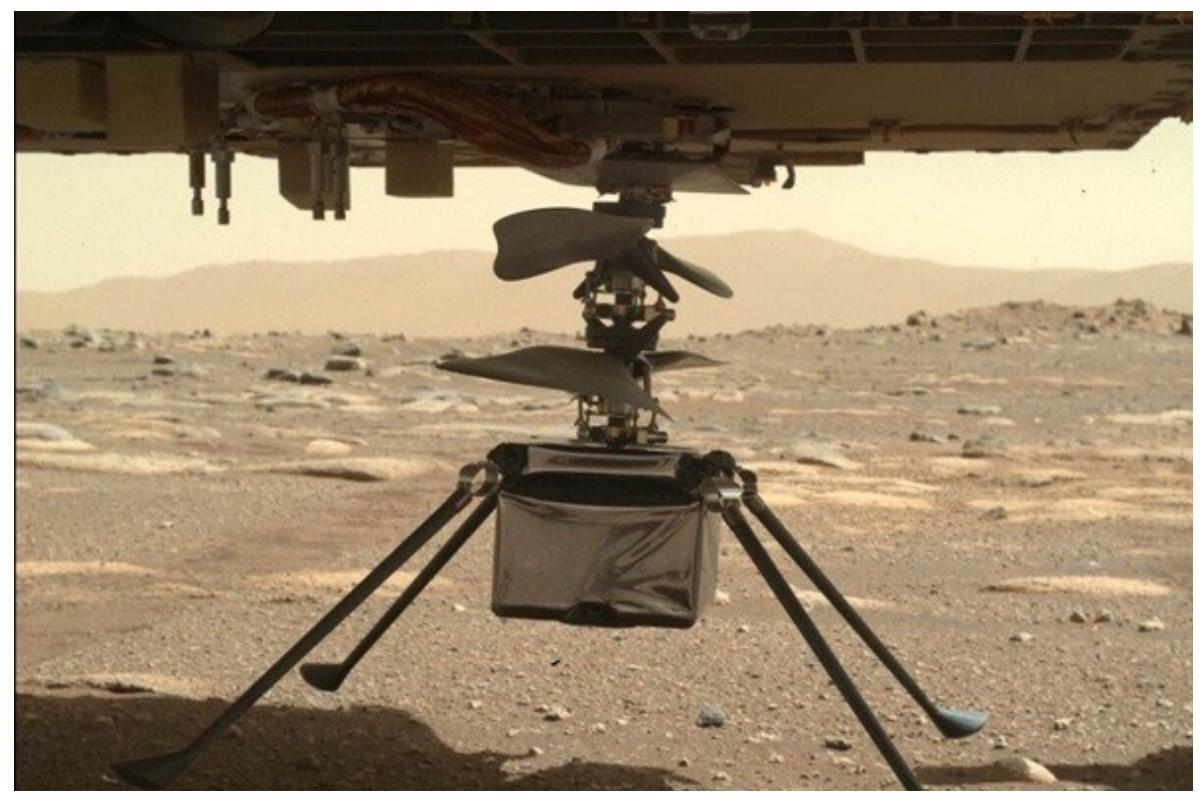
On April 19, 2021, humanity witnessed a “Wright Brothers moment” on another world. A small, autonomous rotorcraft named Ingenuity lifted off the Martian surface, hovered for 39.1 seconds, and landed safely. This was not just a flight; it was the first powered, controlled flight on another planet, a monumental achievement that shattered previous limitations of space exploration. The data from this tiny helicopter, a high-risk, high-reward technology demonstration, has fundamentally changed our approach to exploring other worlds. This guide delves into the incredible story behind Ingenuity, exploring the immense challenges, the brilliant engineering, and the lasting legacy of this historic mission.
The Unprecedented Challenge of Martian Flight
Achieving flight on Mars is exponentially more difficult than on Earth. The primary obstacle is the planet’s incredibly thin atmosphere, which has a density just 1% of Earth’s at sea level. This lack of air molecules means there is very little for rotor blades to push against to generate lift.
Why Mars Makes Flying So Difficult
To compensate for the thin atmosphere, engineers at NASA’s Jet Propulsion Laboratory (JPL) had to design a vehicle that was both incredibly lightweight and powerful. The helicopter’s blades needed to spin at an extremely high velocity—around 2,400 revolutions per minute (RPM), which is about five times faster than a typical helicopter on Earth. Furthermore, Mars’ gravity is only about 38% of Earth’s, which helps with lift but also presents unique challenges for flight stability and control in the thin air. Added to this are the extreme temperature swings, which can drop to -130°F (-90°C) at night, posing a severe risk to the helicopter’s batteries and electronic components.
Overcoming the Engineering Hurdles
The Ingenuity team overcame these challenges through a combination of innovative design and rigorous testing. The helicopter was built using lightweight carbon-fiber materials, bringing its total mass to just 4 pounds (1.8 kilograms). Its two counter-rotating blades, spinning in opposite directions, provided stability and eliminated the need for a tail rotor. The entire system was designed to be autonomous, as the communication delay between Earth and Mars (up to 20 minutes one-way) makes real-time piloting impossible. Ingenuity had to rely on its own sensors and algorithms to navigate, take off, and land safely.

Ingenuity: Anatomy of a Martian Helicopter
Ingenuity is a marvel of compact and efficient engineering. Every component was meticulously designed to maximize performance while minimizing weight and power consumption. It was a technology demonstration, meant to prove that flight was possible, not to conduct science itself.
Core Components and Technical Checklist
Understanding Ingenuity requires looking at its key systems. It was not just a drone; it was a fully-fledged, self-sufficient robotic aircraft designed for a hostile environment.
- Fuselage: A small, box-like body (about the size of a tissue box) housing the batteries, processors, and sensors.
- Rotor System: Two 4-foot (1.2-meter) long carbon-fiber blades arranged in a coaxial, counter-rotating configuration to maximize lift and maintain stability.
- Solar Array: A top-mounted solar panel used to recharge its six lithium-ion batteries, providing the power needed for flight and for heaters to survive the cold Martian nights.
- Landing Legs: Four thin, lightweight legs designed to absorb the impact of landing and ensure stability on uneven terrain.
- Avionics & Sensors: Includes an inertial measurement unit (IMU), altimeter, and a navigation camera to track its position and velocity autonomously.
- Communications: A radio link to communicate with the Perseverance rover, which acted as a base station to relay data back to Earth.
The Symbiotic Relationship with Perseverance
Ingenuity could not have completed its mission alone. It traveled to Mars tucked beneath the belly of the Perseverance rover. The rover was responsible for deploying the helicopter onto the Martian surface, protecting it during its initial checkout phase, and serving as the vital communications relay. Perseverance would receive commands from Earth, transmit them to Ingenuity, and then receive flight data from the helicopter to send back to mission control. This partnership was crucial to the mission’s success.

The Historic First Flight: A Step-by-Step Breakdown
The first flight was a carefully choreographed event, the culmination of years of work. The goal was simple but profound: to prove that a machine built by humans could fly on another planet.
The Pre-Flight Procedure
After being deployed by Perseverance, Ingenuity spent several Martian days (sols) undergoing system checks. Mission controllers on Earth meticulously tested its motors, sensors, and power systems. They performed a high-speed spin-up test of the rotors a few days before the flight to ensure everything was functioning as expected. The flight plan was uploaded, and the helicopter was left to execute the sequence autonomously.
The 39.1 Seconds That Changed History
On the morning of April 19, 2021, Ingenuity’s onboard computers took over. The helicopter spun its blades up to full speed, lifted off the ground, and ascended to an altitude of about 10 feet (3 meters). It hovered in place for approximately 30 seconds, performed a controlled turn to face a new direction, and then descended for a perfect landing. While the flight itself was short, the data it provided was invaluable, confirming that NASA’s flight models for the Martian atmosphere were accurate.
Expert Advice: Lessons from Ingenuity’s Success
The Ingenuity mission offers powerful lessons for future space exploration and complex engineering projects. Its success was not just a technical victory but a strategic one.
Key Takeaways for Future Missions
| Principle | Application & Insight |
|---|---|
| Embrace High-Risk, High-Reward Tech Demos | Ingenuity was a secondary experiment. By separating it from the primary mission of Perseverance, NASA could take a bigger risk. This model allows for groundbreaking innovation without jeopardizing the core scientific objectives of a flagship mission. |
| Leverage Autonomous Systems | The light-speed delay to Mars makes direct control impossible. Ingenuity’s success underscores the critical need for robust, reliable autonomous systems that can make real-time decisions in unpredictable environments. Future exploration will rely even more heavily on AI and machine learning. |
| Iterate and Expand the Mission Scope | Originally planned for just five flights, Ingenuity performed so well that its mission was extended. It completed 72 flights, becoming an aerial scout for Perseverance. This demonstrates the value of building robust systems that can adapt and take on new roles once their primary objectives are met. |
Frequently Asked Questions (FAQ)
-
What happened to the Ingenuity helicopter?
- After far exceeding its planned mission of 5 flights, Ingenuity completed 72 flights over nearly three years. Its mission ended in January 2024 after it sustained damage to one of its rotor blades during a rough landing, rendering it unable to fly again. It now stands silent on the Martian surface as a monument to pioneering exploration.
-
How was Ingenuity controlled from so far away?
- Ingenuity was not controlled in real-time. Engineers on Earth would plan a flight path and upload the sequence of commands to the Perseverance rover, which would then relay them to the helicopter. Ingenuity executed this pre-programmed flight path autonomously using its own sensors to navigate and stabilize itself.
-
Why were Ingenuity’s blades so large and fast?
- The blades had to be exceptionally large (4 feet) and spin incredibly fast (around 2,400 RPM) to generate enough lift in Mars’s extremely thin atmosphere, which has only 1% the density of Earth’s. The combination of large surface area and high speed was necessary to “grab” enough of the few air molecules available to lift the 4-pound vehicle.
-
What is the legacy of the Ingenuity mission?
- Ingenuity’s legacy is profound. It proved that aerial exploration on other planets is possible. This opens the door for future missions that could include more advanced helicopters or drones capable of exploring canyons, caves, and other areas inaccessible to rovers. It added an “aerial dimension” to planetary science.