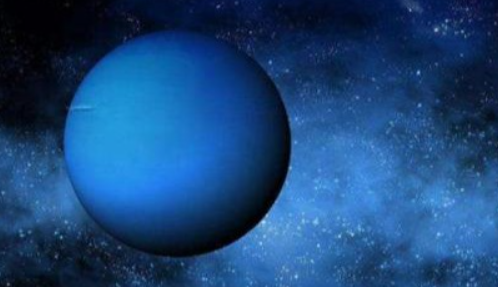
Our solar system is a vast and wondrous place, a gravitationally bound system of the Sun and the objects that orbit it. For billions of years, eight planets have traced their paths around our parent star, each a unique world with its own story. From the rocky, cratered surfaces of the inner planets to the swirling, colossal atmospheres of the gas giants and the frigid, mysterious depths of the ice giants, this guide will take you on a detailed tour of our cosmic neighborhood. We will explore each planet in order, examining their composition, atmosphere, unique features, and the missions that have unveiled their secrets.
Planets in our solar system are broadly categorized into three types. The terrestrial planets (Mercury, Venus, Earth, and Mars) are smaller, rocky worlds with solid surfaces. Beyond them lie the gas giants (Jupiter and Saturn), massive planets composed primarily of hydrogen and helium. Finally, in the farthest reaches, are the ice giants (Uranus and Neptune), which contain heavier volatile substances referred to as “ices,” such as water, ammonia, and methane. Understanding these classifications is key to appreciating the diverse environments that exist within our own solar system.
The Inner Solar System: A Realm of Rock and Fire
The four planets closest to the Sun form the inner solar system. These worlds are characterized by their solid, rocky compositions and are significantly smaller than their outer neighbors. They are worlds of extreme temperatures and dramatic geological histories, including our own home planet.
Mercury: The Swift Messenger
As the closest planet to the Sun, Mercury is a world of incredible extremes. It is the smallest planet in the solar system, only slightly larger than Earth’s Moon. Its surface is heavily cratered, bearing the scars of billions of years of impacts from asteroids and comets. Lacking a significant atmosphere to trap heat, Mercury experiences the most dramatic temperature swings in the solar system, with surface temperatures soaring to 430°C (800°F) during the day and plummeting to -180°C (-290°F) at night. Despite its proximity to the Sun, observations from the MESSENGER spacecraft confirmed the presence of water ice in permanently shadowed craters at its poles.
- Orbital Period: 88 Earth days
- Diameter: 4,879 km
- Key Features: Extreme temperature fluctuations, heavily cratered surface, thin exosphere, water ice in polar craters.
Venus: Earth’s Hellish Twin
Often called Earth’s sister planet due to its similar size and composition, Venus is a world gone wrong. It is shrouded in a thick, toxic atmosphere composed primarily of carbon dioxide, with clouds of sulfuric acid. This atmosphere creates a runaway greenhouse effect, making Venus the hottest planet in the solar system, with surface temperatures of around 465°C (900°F)—hot enough to melt lead. The atmospheric pressure at its surface is over 90 times that of Earth. Venus also rotates on its axis backward (retrograde rotation) compared to most other planets. Future NASA missions like DAVINCI+ and VERITAS aim to study its atmosphere and map its surface to understand why this terrestrial planet evolved so differently from Earth.
- Orbital Period: 225 Earth days
- Diameter: 12,104 km
- Key Features: Runaway greenhouse effect, extreme surface heat and pressure, thick CO2 atmosphere, sulfuric acid clouds, retrograde rotation.
Earth: The Blue Oasis
Our home, Earth, is the only known celestial body to harbor life. Its uniqueness stems from a delicate balance of factors: a distance from the Sun that allows for liquid water to exist on its surface, a protective atmosphere rich in nitrogen and oxygen, and a robust magnetic field that shields it from harmful solar radiation. Earth is a dynamic planet with active geology, including plate tectonics and volcanism, which constantly reshape its surface. Its oceans, which cover about 71% of the surface, are critical to regulating the climate and supporting a vast biosphere.
- Orbital Period: 365.25 Earth days
- Diameter: 12,742 km
- Key Features: Abundant liquid water, life-supporting atmosphere, active plate tectonics, strong magnetic field.
Mars: The Red Planet
Mars has long captured the human imagination as a potential second home. Its distinctive red color comes from iron oxide (rust) on its surface. While its atmosphere is thin (about 1% of Earth’s), Mars shows clear evidence of a more dynamic, watery past, with dried-up riverbeds, deltas, and lakebeds. Today, water exists primarily as ice in its polar caps and beneath the surface. Mars experiences seasons, has towering volcanoes like Olympus Mons (the largest in the solar system), and vast canyon systems like Valles Marineris. Robotic explorers, including the Perseverance rover, are currently searching for signs of ancient microbial life and assessing the planet’s habitability for future human missions.
- Orbital Period: 687 Earth days
- Diameter: 6,779 km
- Key Features: Reddish iron-oxide surface, thin atmosphere, polar ice caps, evidence of past liquid water, massive volcanoes and canyons.

The Gas Giants: Kings of the Solar System
Moving beyond the asteroid belt, we encounter the giants of our solar system. These massive worlds lack a solid surface and are composed almost entirely of gas, primarily hydrogen and helium, surrounding a small, dense core.
Jupiter: The Great Giant
Jupiter is, by far, the largest planet in our solar system—more than twice as massive as all the other planets combined. Its atmosphere is a turbulent tapestry of colorful cloud bands and gigantic storms. The most famous of these is the Great Red Spot, a persistent anticyclonic storm larger than Earth. Jupiter’s powerful magnetic field is nearly 20,000 times stronger than Earth’s, creating intense radiation belts. It also has a faint ring system and a large family of moons, including the four Galilean moons discovered by Galileo Galilei: Io (a volcanically active world), Europa (with a suspected subsurface ocean), Ganymede (the largest moon in the solar system), and Callisto. NASA’s Juno mission continues to orbit Jupiter, revealing new insights into its atmosphere and internal structure.
- Orbital Period: 12 Earth years
- Diameter: 139,820 km
- Key Features: Largest planet, Great Red Spot, powerful magnetic field, numerous moons, turbulent atmosphere.
Saturn: The Lord of the Rings
Saturn is arguably the most visually stunning planet due to its spectacular and complex ring system. While other giants have rings, Saturn’s are the largest and most brilliant. They are composed of countless particles of ice and rock, ranging in size from dust grains to mountains. Saturn itself is the second-largest planet and has the lowest density—it is less dense than water and would float in a sufficiently large bathtub. Its atmosphere features high-speed winds and large storms. Like Jupiter, it has a large collection of moons, with Titan and Enceladus being of particular scientific interest. Titan has a thick, nitrogen-rich atmosphere and lakes of liquid methane, while Enceladus has geysers that spew water ice into space from a subsurface ocean, making it a prime candidate in the search for extraterrestrial life.
- Orbital Period: 29 Earth years
- Diameter: 116,460 km
- Key Features: Extensive and bright ring system, lowest density of any planet, numerous moons including Titan and Enceladus.
The Ice Giants: The Mysterious Outer Realms
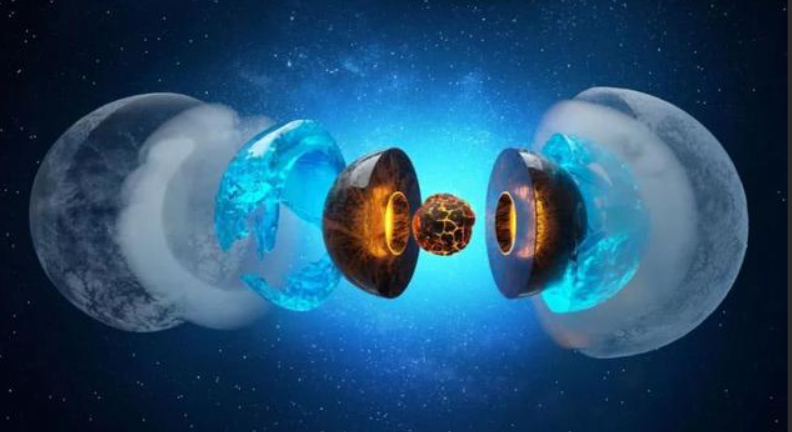
The outermost planets, Uranus and Neptune, are known as ice giants. Their composition differs from the gas giants, as they contain a higher proportion of “ices” like water, ammonia, and methane, surrounding a rocky core. These frigid worlds are the least explored in our solar system.
Uranus: The Sideways Planet
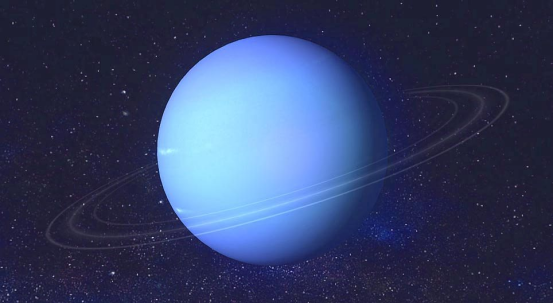
Uranus is unique for its extreme axial tilt of about 98 degrees. It essentially orbits the Sun on its side, which results in extreme seasons, with each pole experiencing 42 years of continuous sunlight followed by 42 years of darkness. Its atmosphere is the coldest in the solar system, with temperatures dropping to -224°C (-371°F). The methane in its upper atmosphere gives it a pale blue-green, featureless appearance. Uranus has a faint ring system and 27 known moons, named after characters from the works of William Shakespeare and Alexander Pope. It has only been visited up close once, by the Voyager 2 spacecraft in 1986.
- Orbital Period: 84 Earth years
- Diameter: 50,724 km
- Key Features: Extreme axial tilt, coldest planetary atmosphere, pale cyan color from methane, faint rings.
Neptune: The Windy Blue World
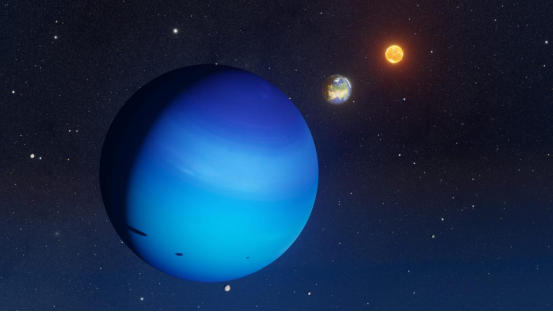
Neptune is the most distant planet from the Sun, a dark, cold, and incredibly windy world. Its deep blue color is also due to methane in its atmosphere, which absorbs red light. Despite its great distance from the Sun’s heat, Neptune has the fastest winds in the solar system, reaching speeds of over 2,000 km/h (1,200 mph). When Voyager 2 flew by in 1989, it observed a large storm system called the Great Dark Spot, similar to Jupiter’s Great Red Spot, though it has since disappeared. Neptune has a thin collection of rings and 14 known moons, the largest of which is Triton, a geologically active moon that orbits Neptune in a retrograde direction.
- Orbital Period: 165 Earth years
- Diameter: 49,244 km
- Key Features: Strongest winds in the solar system, deep blue color, transient storm systems, largest moon Triton.
The Solar System’s Blind Spot: Why Ice Giants Demand Exploration
While we have sent orbiters and landers to the inner planets and gas giants, the ice giants Uranus and Neptune remain largely unexplored, having only been visited by a single spacecraft, Voyager 2, for brief flybys decades ago. This lack of data has made them a “blind spot” in our understanding of planetary formation and evolution. Scientists argue that a dedicated orbiter mission to one or both of these planets is a top priority for several critical reasons.
Understanding Planetary Formation
The ice giants represent a distinct class of planet. Their composition, rich in ices like water and ammonia, sets them apart from the hydrogen-dominated gas giants. Understanding how and where they formed in the early solar system is crucial to completing our models of how planetary systems are built. Did they form in their current orbits, or did they migrate from closer to the Sun? Answering this question would fill a major gap in our knowledge.
A Window into Exoplanet Systems
Astronomical surveys have revealed that planets of a similar size and mass to Uranus and Neptune are extremely common around other stars. These “exo-Neptunes” may be one of the most abundant types of planets in the galaxy. By studying the ice giants in our own backyard in detail, we can gain invaluable ground-truth data to help us interpret observations of these distant exoplanetary systems. Understanding our own ice giants is key to understanding planetary systems throughout the universe.
Unveiling Unique Planetary Processes
The ice giants harbor many mysteries. Uranus’s extreme axial tilt and frigid atmosphere are unexplained, as are the sources of Neptune’s powerful internal heat and supersonic winds. Their magnetic fields are also bizarre—they are not centered on the planet’s core and are tilted at dramatic angles. A dedicated mission with modern instruments could investigate these strange phenomena, providing new insights into planetary dynamics, magnetospheres, and atmospheric science under conditions not found anywhere else in our solar system.
The Future of Solar System Exploration
Humanity’s quest to explore our solar system is ongoing. Future missions are set to push the boundaries of our knowledge even further. The focus is shifting from general reconnaissance to answering specific questions about habitability, planetary evolution, and the potential for life beyond Earth.
Return to Venus and Mars
NASA is planning a return to Venus with the DAVINCI+ and VERITAS missions to study its atmosphere and geology in unprecedented detail. Meanwhile, Mars remains a primary target, with plans for a Mars Sample Return mission to bring back rock and soil samples collected by the Perseverance rover. These samples could finally answer the question of whether life ever existed on the Red Planet.
Exploring Icy Moons
The moons of the outer solar system are now seen as some of the most promising locations to find life. NASA’s Europa Clipper mission will conduct detailed flybys of Jupiter’s moon Europa to investigate its subsurface ocean. Similarly, the Dragonfly mission will send a rotorcraft lander to Saturn’s moon Titan, exploring its complex organic chemistry and methane lakes.
A New Era for the Outer Giants
Looking further ahead, the scientific community is strongly advocating for a flagship mission to Uranus or Neptune. A Uranus Orbiter and Probe is a high-priority concept that would revolutionize our understanding of the ice giants, finally shining a light on this long-neglected region of our solar system and providing context for the thousands of similar worlds discovered around other stars.
Frequently Asked Questions (FAQ)
- What is the difference between a gas giant and an ice giant?
- The primary difference lies in their composition. Gas giants, like Jupiter and Saturn, are composed almost entirely of hydrogen and helium, with only a small rocky core. Ice giants, like Uranus and Neptune, have a much smaller hydrogen and helium envelope and a much larger mantle made of heavier volatile compounds, or “ices,” such as water (H₂O), ammonia (NH₃), and methane (CH₄), surrounding their core.
- Why is Venus so much hotter than Mercury, even though Mercury is closer to the Sun?
- The extreme heat on Venus is caused by a runaway greenhouse effect. Its incredibly dense atmosphere, which is about 96.5% carbon dioxide, traps solar radiation very effectively. While Mercury gets more direct solar energy, its lack of a significant atmosphere means the heat escapes back into space at night. Venus’s thick atmospheric blanket, however, keeps the surface perpetually hot, making it the hottest planet in the solar system.
- Is there a possibility of life on Mars?
- While the current Martian surface is harsh and likely sterile due to thin atmosphere and high radiation, there is strong evidence that Mars was once warmer and wetter. This raises the possibility that microbial life could have existed in its past. Scientists believe that if life still exists on Mars, it would likely be found underground, where it would be protected from the harsh surface conditions and could have access to liquid water.
- What causes Uranus to be tilted on its side?
- The leading theory is that early in its history, Uranus was struck by a massive, Earth-sized protoplanet. This colossal impact is thought to have knocked the planet over, resulting in its extreme axial tilt of 98 degrees. This unique orientation causes extreme seasons unlike any other planet in our solar system.
- Which planet has the most moons?
- As of recent discoveries, Saturn currently holds the title for the planet with the most known moons, having surpassed Jupiter. Both planets have vast systems of moons, with new, smaller moons being discovered periodically by powerful telescopes. These moons range from giant, planet-like worlds such as Ganymede and Titan to small, captured asteroids.