The universe is populated by gargantuan clouds of gas and dust known as nebulae, which serve as both the cradles of new suns and the tombs of dying stars. Understanding these structures requires a multi-dimensional approach that looks at the chemical composition, the gravitational forces at play, and the high-energy radiation that illuminates these cosmic canvases. From the Solar Nebula that birthed our own planetary system to the complex accretion disks feeding distant stars, the story of the cosmos is written in the light and shadow of these nebular clouds.
The Foundations of Cosmic Nebulae: Understanding the Stellar Nurseries
Nebulae are primarily composed of hydrogen, helium, and trace amounts of heavier elements. The process of star formation begins within Molecular Clouds, where high-density regions collapse under their own gravity. This transition from diffuse gas to a structured stellar system is best exemplified by the Solar Nebula model, which describes a rotating disk of material that eventually coalesced into the Sun and planets. This “dance of light and dust” is not merely aesthetic; it is a complex physical interaction where angular momentum and thermal pressure dictate the final architecture of a solar system.
The Role of Accretion Disks in Stellar Growth
As a protostar forms, it is surrounded by an accretion disk. These beautiful spirals are the engines of stellar growth, channeling material onto the central object while providing the raw ingredients for planetary formation. The internal friction within these disks converts gravitational energy into heat, causing the disk to glow and revealing the secrets of how stars gain their mass. Observations of these disks provide critical data on the timescales of planetesimal accumulation and the chemical evolution of young solar systems.
Stellar Evolution in the Rosette Nebula
The Rosette Nebula serves as a premier laboratory for studying stellar evolution. Located in the Monoceros region, this emission nebula is shaped by the intense radiation from a central cluster of hot, young stars. These stars emit ultraviolet radiation that ionizes the surrounding hydrogen gas, creating the characteristic red glow. The “hole” at the center of the Rosette is a result of stellar winds pushing the gas outward, demonstrating the feedback mechanisms that eventually halt star formation by dispersing the remaining gas supply.

Diverse Classifications: From Emission to Reflection Nebulae
Astronomers categorize nebulae based on how they interact with light. While emission nebulae glow with their own light due to ionization, reflection nebulae act like cosmic mirrors. These objects, such as NGC 1432 (the Maia Nebula in the Pleiades) and IC 4605 near the star Antares, do not have enough energy to ionize the gas. Instead, the dust particles within them scatter the light from nearby stars. Because blue light scatters more efficiently than red light, these nebulae often appear as striking blue veils or “sapphires” in the dark expanse of space.
The Sapphire of Cepheus: NGC 7023
NGC 7023, also known as the Iris Nebula, is a classic example of a reflection nebula located in the constellation Cepheus. Unlike the chaotic star-forming regions of emission nebulae, the Iris Nebula displays a delicate, symmetrical structure. The central star, SAO 19158, illuminates the surrounding dust, creating a deep blue hue that provides insights into the size and composition of interstellar dust grains. Studying the polarization of light from NGC 7023 allows scientists to map the magnetic fields and density variations within the interstellar medium.
Reflection Landscapes in Scorpius: IC 4592 and IC 4601
In the constellation Scorpius, the Blue Horsehead Nebula (IC 4592) provides a stunning example of how perspective and lighting create recognizable shapes in the cosmos. This reflection nebula is illuminated by the bright star Jabbah. Nearby, IC 4601 adds to the complex landscape of gas and dust. These regions are critical for understanding how light interacts with complex organic molecules, such as Polycyclic Aromatic Hydrocarbons (PAHs), which are often found embedded in these dusty clouds.
| Nebula Type | Primary Mechanism | Common Color | Example Objects |
|---|---|---|---|
| Emission | Ionization of gas by UV radiation | Red (H-alpha) | Orion, Rosette, Heart |
| Reflection | Scattering of starlight by dust | Blue | NGC 1432, NGC 7023, IC 4592 |
| Planetary | Expulsion of outer layers by aging stars | Green/Blue/Red | Dumbbell, Cat’s Eye |
| Supernova Remnant | Shockwaves from stellar explosion | Multispectral | Crab Nebula |

Iconic Deep-Sky Objects: A Detailed Tour of the Universe
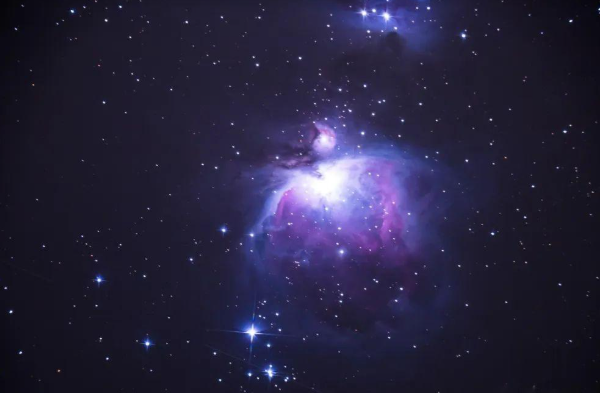
Certain nebulae have become icons of astronomy due to their scale and complexity. The Orion Nebula (M42) is perhaps the most famous, visible even to the naked eye. It is a “majestic stage” of star birth where the light and shadow reveal the Trapezium Cluster, a group of four massive stars that dominate the nebula’s energetics. The interaction between the intense radiation from these stars and the surrounding cold gas creates “proplyds”—protoplanetary disks that are currently being eroded by the harsh environment.
The Carina Nebula: A Magnificent Sculpture
The Carina Nebula is one of the largest diffuse nebulae in our skies, far larger and brighter than the Orion Nebula. It contains Eta Carinae, one of the most massive and unstable stars known. The nebula is a landscape of pillars, ridges, and “mountains” of gas, sculpted by the fierce winds of the many O-type stars it hosts. The Mystic Mountain, a famous sub-structure within Carina, showcases how star-forming jets can punch through the surrounding material, creating towering structures of gas and dust.
The Pulsating Heart Nebula
Located in the Perseus Arm of the Galaxy, the Heart Nebula (IC 1805) is characterized by its distinct heart-like shape. At its center lies Melotte 15, a small cluster of stars that are roughly 1.5 million years old. These stars are responsible for the “fiery beauty” of the nebula, as their radiation carves out the interior of the cloud. The Heart Nebula is often studied alongside the nearby Soul Nebula, together forming a massive complex of star formation that spans hundreds of light-years.

The Physics of Stellar Evolution: From Gas Clouds to Supernova Remnants
Nebulae also mark the end of the stellar life cycle. Planetary nebulae, such as the Dumbbell Nebula (M27), occur when a medium-sized star exhausts its nuclear fuel and sheds its outer layers. The remaining core, a white dwarf, emits ultraviolet radiation that causes the expelled gas to glow. The Dumbbell Nebula provides a “revealed” look at the internal structure of a dying star, showing the complex shells and knots of gas that form during this transition.
Hubble’s Eye: The Cat’s Eye Nebula
The Cat’s Eye Nebula (NGC 6543) is one of the most complex planetary nebulae ever observed. High-resolution images from the Hubble Space Telescope reveal concentric rings, jets, and unusual filamentary structures. Astronomers believe these patterns are caused by a binary star system at the center, where the interaction between two stars wobbles the axis of gas expulsion. This nebula serves as a warning of the future of our own Sun, which will eventually create a similar, albeit perhaps less complex, planetary nebula.
The Crab Nebula: Aftermath of a Supernova
In contrast to the gentle shedding of layers in planetary nebulae, the Crab Nebula (M1) is the result of a violent supernova explosion recorded by astronomers in 1054 AD. This supernova remnant is powered by a pulsar—a rapidly rotating neutron star—at its center. The pulsar emits a “wind” of high-energy particles that causes the nebula to glow across the entire electromagnetic spectrum, from radio waves to gamma rays. The Crab Nebula is a spectacular show of “synchrotron radiation,” where electrons spiraling in magnetic fields emit light, providing a unique laboratory for high-energy astrophysics.

Advanced Observation and Astrophotography Strategies for Nebulae
Capturing the intricate details of nebulae requires specialized equipment and techniques. The Lagoon Nebula (M8) is an excellent target for both amateur and professional astrophotographers. Due to its high surface brightness, it reveals significant detail in relatively short exposures. To capture the “fiery” reds and “dreamy” blues, photographers often use narrowband filters (H-alpha, OIII, and SII), which isolate the specific wavelengths of light emitted by ionized gases.
Exploring the Treasure of Cygnus: The North America Nebula
The North America Nebula (NGC 7000) in Cygnus is another favorite target. Its massive size means it is best captured with wide-field telescopes. The nebula’s resemblance to the North American continent is created by a dark absorption cloud (the “Gulf of Mexico” region) that sits in front of the glowing emission nebula. To photograph this region effectively, one must account for the high density of stars in the Milky Way plane, often using “star reduction” techniques in post-processing to highlight the subtle textures of the gas.
The Bubble Nebula and Stellar Winds
The Bubble Nebula (NGC 7635) presents a unique challenge for observers. The “bubble” is created by the stellar wind from a massive hot star (BD+60 2522) pushing against a dense molecular cloud. This creates a delicate shell that requires high-resolution imaging to resolve. The size of the bubble—approximately 7 light-years across—is a testament to the sheer power of stellar winds. Observing such structures helps astronomers calculate the mass-loss rates of massive stars and the pressure balance within the interstellar medium.
Frequently Asked Questions (FAQ)
- Q1: What is the primary difference between an emission nebula and a reflection nebula?
- The primary difference lies in the source of light. Emission nebulae, like the Orion or Rosette, contain ionized gas (mostly hydrogen) that glows because it is energized by high-energy ultraviolet radiation from nearby stars. Reflection nebulae, such as NGC 1432 or IC 4605, do not contain ionized gas; instead, they consist of dust that reflects and scatters the light of nearby stars, typically appearing blue because blue light scatters more easily than red.
- Q2: How does the “Solar Nebula” theory explain the formation of our solar system?
- The Solar Nebula theory suggests that our solar system formed from a giant, rotating cloud of gas and dust. As gravity caused the cloud to collapse, it spun faster and flattened into a disk. The center became the Sun, while the remaining material in the accretion disk collided and clumped together to form planetesimals, which eventually grew into the planets, moons, and asteroids we see today.
- Q3: Why is the Crab Nebula considered one of the most important objects in astronomy?
- The Crab Nebula is unique because its origin is tied to a specific historical event (the 1054 AD supernova). It contains a pulsar at its center, which acts as a powerful engine, accelerating particles to nearly the speed of light. This allows scientists to study supernova physics, pulsar wind nebulae, and high-energy radiation mechanisms in a way that is not possible with other remnants.
- Q4: What causes the intricate shapes seen in planetary nebulae like the Cat’s Eye?
- The complex structures in planetary nebulae are often the result of binary star interactions, magnetic fields, and “precessing” jets of gas. As a dying star expels its layers, if it has a companion star, the gravitational pull and orbital motion can “wobble” the outflow, creating concentric rings, spirals, and symmetric lobes rather than a simple spherical shell.
- Q5: What are the best conditions for observing deep-sky nebulae like the Lagoon or North America Nebula?
- Optimal observation requires “dark skies” far from city light pollution. Since many nebulae emit light in specific wavelengths (like the H-alpha red), using specialized UHC (Ultra High Contrast) or OIII filters can significantly improve the view through a telescope. For astrophotography, long-exposure tracking on an equatorial mount is essential to capture the faint details of the gas structures.