The Historic Search for Martian Water: Early Theories and Discoveries
The quest for water on Mars is not a recent phenomenon but a scientific odyssey stretching back centuries. Early astronomers, peering through rudimentary telescopes, observed changing polar caps and dark surface features, leading to speculative theories about Martian seas and vegetation. These initial observations, though often misinterpreted, ignited a fascination that would drive generations of planetary scientists.
Pioneering Observations and Canal Mania
In the late 19th and early 20th centuries, astronomers like Giovanni Schiaparelli and Percival Lowell made detailed maps of Mars. Schiaparelli famously described linear features he called “canali” (channels), which Lowell later popularized as artificial canals built by an intelligent Martian civilization to transport water from the poles to arid regions. This theory, though later debunked, profoundly influenced public perception and scientific inquiry:
- Schiaparelli’s “Canali”: His 1877 observations during a close approach of Mars led to the detailed mapping of numerous linear features, interpreted by some as evidence of Martian engineering.
- Lowell’s Martian Civilization: Percival Lowell, an American astronomer, dedicated much of his life to studying Mars from his observatory in Flagstaff, Arizona, creating elaborate maps of the “canals” and advocating strongly for their artificial origin, fueled by the necessity of water distribution on a dying planet.
- Spectroscopic Analysis: Early spectroscopic studies attempted to detect water vapor in the Martian atmosphere, yielding inconclusive results but highlighting the planet’s extreme aridity compared to Earth.
These early conjectures, while scientifically inaccurate, established water as a central theme in the exploration of Mars, setting the stage for more rigorous, evidence-based investigations.

Unveiling Mars’ Ancient Wet Past: Evidence of Vast Oceans and Rivers
Decades of robotic missions have transformed the understanding of Mars from a dry, desolate world to one that once harbored vast quantities of liquid water. Geological evidence, meticulously gathered by orbiters and rovers, paints a vivid picture of a planet with a warm, wet past, featuring expansive oceans, flowing rivers, and active hydrological cycles.
Geological Signatures of Ancient Water
The surface of Mars is replete with features that are unmistakably carved by water. These include ancient river valleys, deltaic deposits, and sedimentary layers, all indicative of sustained liquid flow over geological timescales. The presence of specific mineral types further corroborates this narrative:
- Valley Networks: Extensive networks of branching valleys, particularly in the ancient southern highlands, strongly resemble terrestrial river systems, suggesting prolonged periods of rainfall or groundwater outflow.
- Deltaic Deposits: Features such as the Jezero Crater delta, explored by the Perseverance rover, provide compelling evidence of ancient lakes fed by rivers, where sediments were deposited over millions of years, potentially preserving biosignatures.
- Layered Sedimentary Rocks: Outcrops of layered rocks, observed by rovers like Opportunity and Curiosity, are consistent with deposition in ancient lakes or seas, similar to how sedimentary rocks form on Earth.
Mineralogical Proof: Hydrated Minerals
Beyond surface morphology, the chemical composition of Martian rocks and soil offers undeniable proof of water’s historical presence. Orbiters and rovers have detected a wide array of hydrated minerals, which form exclusively in the presence of liquid water:
- Hematite Spheres (“Blueberries”): Discovered by the Opportunity rover, these small, spherical concretions of hematite are characteristic of formation in water-rich environments. Their presence was a pivotal early discovery for Mars’ wet past.
- Clay Minerals (Phyllosilicates): Identified by missions like Mars Express and Mars Reconnaissance Orbiter, phyllosilicates are common on early Mars and form through the alteration of volcanic rock by water. They are excellent preservers of organic material.
- Sulfate Salts: Minerals like gypsum and jarosite, found in various locations, indicate the evaporation of salty water bodies, suggesting a dynamic hydrological system that included both fresh and saline environments.
Collectively, these geological and mineralogical findings provide robust evidence that early Mars was a dramatically different world, potentially capable of supporting life.

The Red Planet’s Hue: How Water Shaped Mars’ Distinctive Color
Mars is famously known as the “Red Planet,” a descriptor derived from its pervasive rusty hue. This iconic color is not merely superficial; it is a direct consequence of the planet’s geological and hydrological history, intricately linked to the presence and interaction of water and iron over billions of years.
Oxidation and the Formation of Iron Oxides
The reddish-orange color of Mars is primarily due to the abundance of iron oxides, specifically ferric oxide, which is essentially rust. This rust forms when iron-rich minerals on the Martian surface react with oxygen. While Mars’ current atmosphere is thin and largely devoid of free oxygen, its ancient environment was far more dynamic:
- Early Volcanic Activity: Mars has a rich volcanic history, which brought iron-rich basalts to the surface. These minerals provided the raw material for oxidation.
- Water as a Catalyst: Liquid water, abundant in Mars’ early history, acted as a crucial medium for the chemical weathering of these iron-bearing rocks. Water facilitates the transport of ions and accelerates the oxidation process, much like how rust forms on iron objects on Earth.
- Atmospheric Processes: While water was key, atmospheric processes also played a role. Over geological time, even small amounts of atmospheric oxygen, possibly released from water molecules broken down by ultraviolet radiation, could have contributed to the widespread oxidation.
The Role of a Wet Environment in Reddening Mars
Recent research suggests that the ubiquitous red color of Mars could have formed more efficiently and extensively in a wet environment. This hypothesis challenges older views that primarily focused on atmospheric oxidation over vast timescales. The presence of liquid water would have allowed for the rapid and widespread formation of iron oxides through several mechanisms:
- Hydrothermal Systems: In areas with volcanic activity and subsurface water, hydrothermal systems could have circulated hot, mineral-rich water, accelerating the alteration of rocks and the formation of rust.
- Sedimentary Processes: As water flowed across the surface, it would have picked up and transported iron-rich sediments. In lakes and oceans, these sediments would have settled and undergone chemical reactions, leading to the deposition of reddish iron oxides.
- Mineral Alteration: Water chemically alters primary minerals like olivine and pyroxene, found in Martian basalts, into secondary minerals such as clays and sulfates. These alteration products often contain iron that is more susceptible to oxidation, leading to the characteristic red color.
Therefore, the Red Planet’s iconic color serves as a geological testament to its water-rich past, a permanent marker of the profound impact hydrological processes had on its surface chemistry and appearance.

Subsurface Secrets: The Hunt for Hidden Liquid Water on Mars Today
While Mars’ ancient surface water is long gone, the search for water continues, shifting focus to the planet’s subsurface. Scientific instruments aboard orbiters and landers are now revealing tantalizing evidence of present-day water, primarily in the form of ice and potentially even pockets of liquid brine hidden beneath the Martian crust.
Evidence of Subsurface Ice and Liquid Brine
The extreme cold and low atmospheric pressure on Mars make surface liquid water unstable. However, conditions beneath the surface can allow water to persist in various forms:
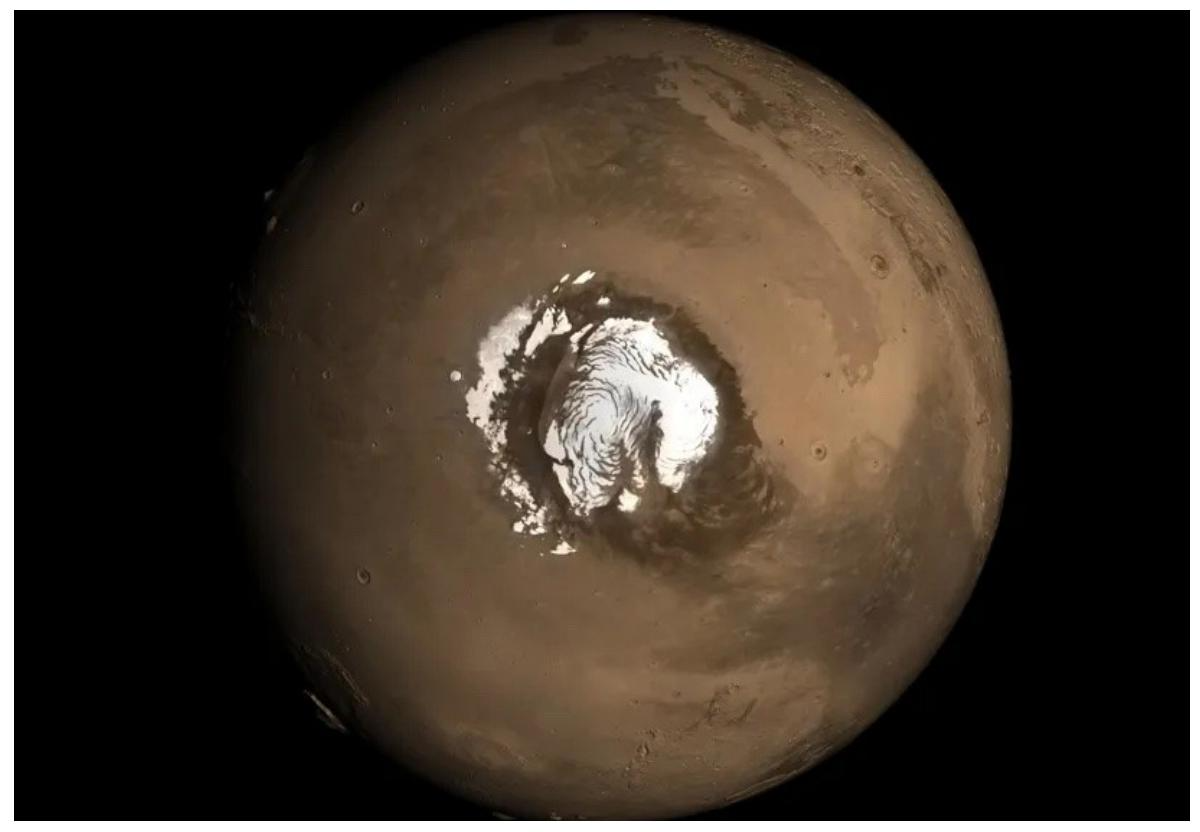
- Polar Ice Caps: Both the north and south polar regions host massive ice caps composed of water ice, mixed with frozen carbon dioxide, which grow and recede seasonally. These represent the largest known reservoirs of water on Mars.
- Subsurface Ice Deposits: Radar instruments like MARSIS (Mars Advanced Radar for Subsurface and Ionospheric Sounding) on Mars Express and SHARAD (Shallow Radar) on Mars Reconnaissance Orbiter have detected extensive layers of buried water ice, particularly at mid-latitudes. These deposits could be remnants of past glaciation.
- Recurring Slope Lineae (RSL): These dark streaks appear seasonally on warm Martian slopes and are thought to be caused by briny water flowing just beneath the surface. While direct liquid water has not been confirmed, the hypothesis of hydrated salts lowering the freezing point of water remains strong.
The Discovery of Subglacial Lakes and Oceans
Perhaps the most exciting recent discoveries point to the potential for large bodies of liquid water resembling oceans hidden deep within Mars’ crust. Radar data has been crucial in these findings:
- MARSIS Radar Detections: In 2018, MARSIS data revealed a strong radar reflection beneath the south polar ice cap, interpreted as a subglacial lake of liquid water, approximately 20 kilometers wide. Subsequent studies using MARSIS have suggested the presence of several such liquid-water bodies, potentially interconnected.
- Implications for Habitability: These subglacial reservoirs, if confirmed, would represent significant environments for potential extant life on Mars. The presence of salts would lower the freezing point, allowing water to remain liquid even at very low temperatures, and the surrounding rock could provide chemical energy sources.
- Challenges and Confirmations: Interpreting radar signals in planetary science is complex, and further missions or advanced radar techniques would be needed to definitively confirm the nature and extent of these subsurface liquid water bodies. However, the evidence strongly points towards a dynamic subsurface hydrological system.
The ongoing exploration of Mars’ subsurface holds the key to understanding the planet’s current habitability and its long-term geological evolution, providing critical insights into the resilience of water in extreme planetary environments.

Implications of Martian Water: Life, Colonization, and Future Exploration
The presence of water on Mars, both past and present, carries profound implications that extend far beyond geological curiosity. It directly impacts the search for extraterrestrial life, the feasibility of human colonization, and the trajectory of future space exploration missions, making it one of the most critical factors in Martian science.
Astrobiological Significance: The Search for Life
Water is universally considered the most essential ingredient for life as we know it. Its discovery on Mars, particularly in liquid form, dramatically enhances the planet’s astrobiological potential:
- Past Habitability: The evidence of ancient lakes, rivers, and possibly oceans on early Mars suggests that the planet once possessed conditions conducive to the emergence and sustenance of microbial life. Missions like Perseverance are actively searching for biosignatures in these ancient lakebeds.
- Present Habitability: The potential for subsurface liquid water, especially briny environments, opens the door to the possibility of extant microbial life surviving in protected niches beneath the surface. These environments would be shielded from harsh surface radiation and extreme temperature fluctuations.
- Understanding Life’s Origins: Studying Martian water and any associated life forms (past or present) could provide invaluable insights into the universal conditions necessary for life and whether life is a common phenomenon in the cosmos.
Enabling Human Colonization and Resource Utilization
For future human missions to Mars, water is not just a scientific target but a vital resource. Its availability on the planet significantly reduces the logistical challenges and costs of human exploration and potential colonization:
- Drinking Water and Life Support: Water can be processed for direct consumption by astronauts and used in life support systems, eliminating the need to transport vast quantities from Earth.
- Propellant Production: Water can be electrolyzed into hydrogen and oxygen, which are critical components for rocket fuel. This “in-situ resource utilization” (ISRU) could enable Mars-to-Earth return missions and further exploration of the solar system from Mars.
- Agriculture and Habitats: Water is essential for growing food in Martian greenhouses and for creating breathable atmospheres within future habitats. The ability to extract and utilize Martian water is a cornerstone of long-term self-sufficiency.
Guiding Future Exploration Strategies
The ongoing discoveries about Martian water are continually refining the scientific objectives and landing site selections for future missions. Understanding the distribution, state, and history of water is paramount for:
- Targeted Sample Return: Missions are being designed to collect samples from locations with high astrobiological potential (e.g., ancient lakebeds, subsurface ice regions) for return to Earth for detailed analysis.
- New Instrumentation: Development of advanced radar, drilling, and analytical instruments capable of penetrating deeper into the Martian crust to directly access and characterize subsurface water and potential life.
- Planetary Protection: Strict protocols are in place to prevent forward contamination of potentially habitable Martian environments by Earth microbes, underscoring the importance of water for potential life.
In essence, water on Mars is the linchpin of our understanding of the planet’s past, its potential for life, and humanity’s aspirations to become a multi-planetary species. The journey of discovery continues, promising even more profound insights in the years to come.
Frequently Asked Questions (FAQ)
- Q1: Was there really an ocean on Mars?
- Scientific evidence, including ancient shorelines, valley networks, and mineralogical findings like clay minerals and sulfates, strongly suggests that early Mars hosted a vast ocean, primarily in its northern lowlands. This ocean likely existed billions of years ago during a period when Mars had a thicker atmosphere and warmer climate, supporting a robust hydrological cycle.
- Q2: Where is the water on Mars today?
- Today, most of Mars’ water is locked up as ice. Large quantities are found in the polar ice caps, which are mixtures of water ice and frozen carbon dioxide. Significant amounts of water ice are also buried beneath the surface, particularly at mid-latitudes. Recent radar data also indicates the potential presence of liquid, salty water (brine) lakes hidden deep beneath the south polar ice cap.
- Q3: How did water affect Mars’ red color?
- Mars’ distinctive red color is due to the abundance of iron oxides, or rust, on its surface. Liquid water played a crucial role in forming these oxides. Water acted as a solvent and a medium for chemical reactions, facilitating the weathering of iron-rich rocks and accelerating the oxidation process. A wet environment allowed for widespread and efficient rusting of the Martian surface over geological time.
- Q4: Why is finding water on Mars important for human missions?
- Finding water on Mars is paramount for future human exploration and colonization. Water can be used for drinking, hygiene, and growing food in habitats. Crucially, it can be broken down into hydrogen and oxygen to produce rocket fuel (propellant) for return journeys to Earth or further space travel, significantly reducing the mass that needs to be launched from Earth.
- Q5: Could life exist in Mars’ subsurface water?
- The potential existence of subsurface liquid water, especially salty brines, greatly increases the chances of finding extant microbial life on Mars. These environments would offer protection from the harsh surface radiation and extreme temperatures, providing a more stable niche for life to potentially survive. The salts would also lower the freezing point, keeping water liquid even in sub-zero conditions.