
The Sun stands as the undisputed sovereign of our celestial neighborhood, a massive G-type main-sequence star that contains more than 99.8% of the total mass of the solar system. It is not merely a static ball of light but a dynamic, roiling engine of plasma that dictates the gravitational stability and the energetic environment of every planet in its orbit. Understanding the Sun requires a multi-dimensional approach, looking at its internal structural mechanics, its turbulent atmosphere, and the far-reaching influence of the particles it ejects into space.
The Astronomical Architecture of the Sun
The Sun is structured into distinct layers, each characterized by specific temperatures, pressures, and physical behaviors. These layers work in concert to transport energy from the central engine out into the vacuum of space.
The Core: The Fusion Reactor
At the very center of the Sun lies the core, a region of unimaginable pressure and temperature exceeding 15 million degrees Celsius. Here, the process of nuclear fusion occurs, specifically the proton-proton chain reaction. In this process, hydrogen nuclei are fused together to form helium, releasing a staggering amount of energy in the form of gamma rays and neutrinos. This energy is the fundamental source of all light and heat in the solar system.
Radiative and Convective Zones
Surrounding the core is the radiative zone, where energy travels outward primarily through radiation. Photons generated in the core bounce around in a “random walk,” taking hundreds of thousands of years to escape this dense layer. Beyond this lies the convective zone, where the plasma becomes less dense and cooler. In this region, energy is moved via convection currents—massive loops of rising hot plasma and sinking cooler plasma—similar to the movement of water in a boiling pot.
Solar Atmosphere and the Mystery of the Corona
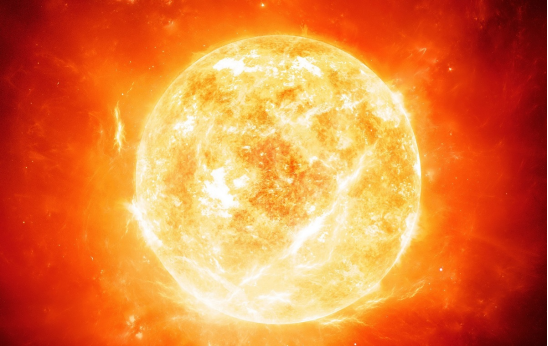
The solar atmosphere is composed of several layers that transition from the visible surface into the thin, hot outer reaches of the Sun’s influence. Each layer presents unique phenomena that astronomers continue to study with advanced space-based observatories.
The Photosphere and Chromosphere
The photosphere is the visible “surface” of the Sun, though it is not a solid boundary. It is the layer from which sunlight is emitted and where sunspots—regions of intense magnetic activity and lower temperatures—frequently appear. Above the photosphere lies the chromosphere, a thin layer that glows with a reddish hue during solar eclipses. This region is marked by spicules, which are jet-like eruptions of gas that shoot upward at high speeds.
The Corona: The Million-Degree Enigma
The corona is the outermost layer of the solar atmosphere, extending millions of kilometers into space. It is characterized by an extremely low density but an incredibly high temperature, often reaching 1 to 3 million degrees Celsius. This creates a scientific paradox: the corona is significantly hotter than the photosphere below it. Current research suggests that magnetic reconnection and “nanoflares” are responsible for pumping this extraordinary amount of heat into the corona.

Solar Dynamics: Flares and Coronal Mass Ejections
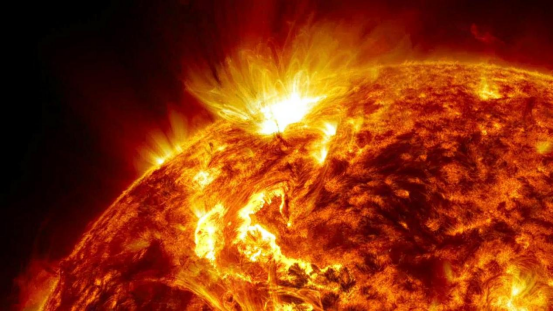
The Sun’s magnetic field is constantly twisting and reorganizing, leading to explosive releases of energy known as solar flares and Coronal Mass Ejections (CMEs). These events are the primary drivers of space weather.
The Mechanism of Solar Flares
A solar flare is a sudden, intense blast of radiation coming from the release of magnetic energy associated with sunspots. These flares are the solar system’s largest explosive events. They release energy across the entire electromagnetic spectrum, from radio waves to gamma rays. While the light from a flare reaches Earth in about eight minutes, the radiation can disrupt high-frequency radio communications and impact satellite electronics almost immediately.
CMEs: The Solar System’s Largest Explosions
While flares are bursts of light and radiation, Coronal Mass Ejections (CMEs) involve the actual expulsion of billions of tons of solar plasma and magnetic fields. These massive clouds of charged particles travel through the solar system at speeds ranging from 250 to 3,000 kilometers per second. When a CME is directed toward Earth, it can cause significant disturbances in the interplanetary magnetic field.
The Solar Wind: A Constant Stream of Particles
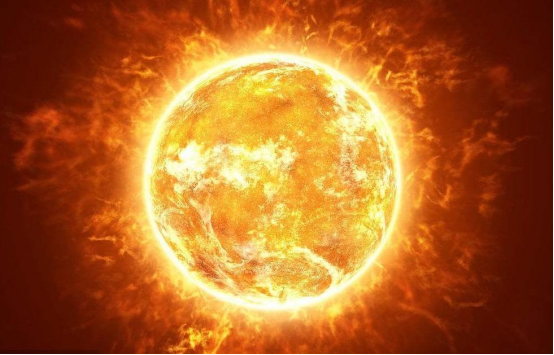
The Sun does not just emit light; it also releases a continuous stream of charged particles known as the solar wind. This wind creates a “bubble” in space called the heliosphere, which protects the solar system from high-energy cosmic radiation.
Origin and Composition of Solar Wind
The solar wind consists mainly of electrons, protons, and alpha particles (helium nuclei). It originates in the corona, where the Sun’s gravity is unable to hold onto the high-temperature plasma. The particles escape along magnetic field lines that open into interplanetary space. The density and speed of the solar wind vary depending on the solar cycle and the presence of coronal holes.
High-Speed vs. Slow-Speed Streams
Solar wind is categorized into two main types:
- Slow Solar Wind: Traveling at approximately 300-500 km/s, this stream likely originates from the Sun’s equatorial regions and is associated with the “closed” magnetic field lines of the streamer belt.
- Fast Solar Wind: Reaching speeds of up to 800 km/s, these streams originate from coronal holes—areas where the magnetic field is “open” to space, allowing particles to escape more easily.
Impact on Earth: From Auroras to Technological Threats
When the solar wind and CMEs interact with Earth’s environment, they trigger a series of physical changes known as geomagnetic storms. These interactions produce both beautiful natural phenomena and significant risks to modern infrastructure.
The Earth’s Magnetosphere Shield
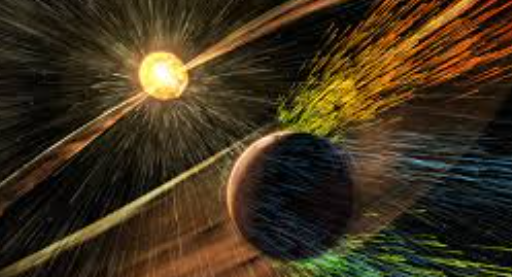
Earth is protected by its magnetosphere, a magnetic “shield” generated by our planet’s core. Most of the solar wind is deflected around this shield. However, during intense solar activity, the solar magnetic field can “reconnect” with Earth’s magnetic field, allowing charged particles to enter the upper atmosphere near the poles.
Visual Spectacles: Aurora Borealis and Australis
As these solar particles collide with gases in Earth’s atmosphere (such as oxygen and nitrogen), they release energy in the form of light. This creates the Auroras—the Northern and Southern Lights. The colors depend on the altitude and the type of gas involved; for example, oxygen produces green and red light, while nitrogen produces blue and purple hues.
Risks to Modern Infrastructure
Beyond the visual beauty, geomagnetic storms pose serious threats. The influx of energy can induce electrical currents in power grids, leading to transformer failures and widespread blackouts. Additionally, the increased radiation can damage satellite hardware, degrade GPS accuracy, and pose health risks to astronauts and passengers on high-altitude polar flights.
Monitoring and Predicting Solar Weather
Given our reliance on technology, monitoring the Sun has become a critical global priority. Scientists use a fleet of spacecraft to provide early warnings of solar events.
Space-Based Observatories
Instruments like the Solar and Heliospheric Observatory (SOHO), the Solar Dynamics Observatory (SDO), and the Parker Solar Probe provide constant surveillance of the Sun. These missions allow us to track the development of sunspots and the trajectory of CMEs with high precision. The Parker Solar Probe, in particular, is “touching the Sun” by flying through the corona to gather data on solar wind acceleration.
The Importance of Space Weather Forecasting
Space weather forecasting is now as vital as terrestrial weather reporting. By predicting when a CME will hit Earth, power grid operators can implement protective measures, and satellite controllers can put sensitive equipment into “safe mode” to prevent permanent damage.
Frequently Asked Questions (FAQ)
- Q1: What is the difference between a solar flare and a CME?
- A solar flare is a sudden burst of light and high-energy radiation, while a Coronal Mass Ejection (CME) is a massive expulsion of plasma and magnetic fields. Flares reach Earth in minutes, whereas CMEs take one to three days to arrive.
- Q2: How does the Sun produce energy?
- The Sun produces energy through nuclear fusion in its core. Hydrogen atoms are fused under extreme pressure and temperature to form helium, releasing energy as photons and neutrinos in the process.
- Q3: Can solar activity affect my daily life?
- Yes, during intense solar storms, GPS signals may become less accurate, and there is a small risk of power grid disturbances. However, for most people, the most noticeable effect is the appearance of auroras at lower latitudes than usual.
- Q4: Why is the Sun’s corona so much hotter than its surface?
- This is known as the “coronal heating problem.” Scientists believe it is caused by magnetic energy being converted into heat through processes like magnetic reconnection and small-scale explosions called nanoflares.
- Q5: What is the solar cycle?
- The solar cycle is a roughly 11-year period during which the Sun’s magnetic activity waxes and wanes. It is characterized by the number of sunspots; at “solar maximum,” activity is highest, leading to more flares and CMEs.