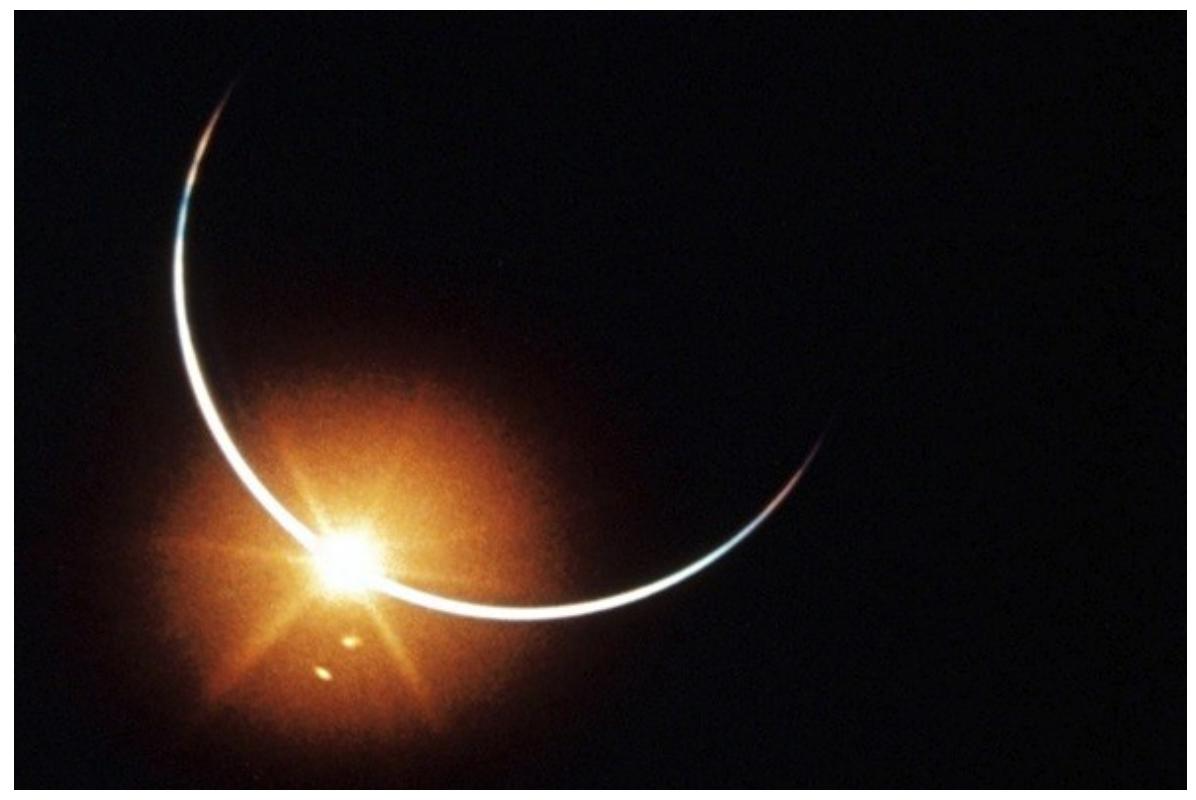
From Earth, a total solar eclipse is a rare and awe-inspiring event where the day momentarily turns into twilight. The Moon perfectly obscures the Sun, revealing the solar corona in a breathtaking display. But what if we could witness this cosmic alignment from the surface of the Moon? The perspective shift is profound. Instead of our sky darkening, we would see a precise, moving shadow cast upon the bright blue marble of our home planet. This guide delves into the science and spectacle of viewing a solar eclipse from our natural satellite.
Understanding the Celestial Mechanics of an Eclipse
To comprehend the view from the Moon, we must first understand the fundamental principles governing eclipses. It’s a precise cosmic ballet involving the Sun, Earth, and Moon, an alignment known as “syzygy.”
The Earth-Moon-Sun Alignment
A solar eclipse, as seen from Earth, occurs when the Moon passes directly between the Sun and Earth, casting a shadow onto our planet. From the Moon’s perspective, this same event is essentially an eclipse of the Earth. You are standing on the object casting the shadow, not the one being shadowed. The Earth, which dominates the lunar sky, would be the stage for this dramatic event.
Defining the Lunar Shadow: Umbra and Penumbra
The shadow cast by the Moon is not uniform. It has two distinct parts that create different experiences for observers on Earth and a complex visual for an observer on the Moon.
- The Umbra: This is the darkest, central part of the shadow. From a location on Earth within the umbra, the Sun is completely blocked, resulting in a total solar eclipse. From the Moon, the umbra would appear as a small, sharp, black circle racing across the Earth’s surface.
- The Penumbra: This is the fainter, outer part of the shadow where the Sun is only partially obscured. On Earth, observers in the penumbra see a partial eclipse. From the Moon, this would be a larger, more diffuse, grayish region surrounding the stark black umbra.

The Visual Spectacle: A Shadow on a Blue Marble
For a hypothetical astronaut on the Moon, the event would not be about the sky going dark, but about watching a piece of Earth’s day being temporarily erased. The sight would be a dynamic and mesmerizing display of celestial mechanics in action.
The Shadow’s Transit
The most prominent feature would be this dark spot moving across the sunlit face of the Earth. Unlike the slow crawl of celestial objects, this shadow would move at over 1,000 miles per hour, visibly tracking across continents and oceans in a matter of hours. You would witness a localized “night” sweeping over the planet.
Earth’s Atmospheric Glow: The Ring of Sunsets
A truly unique and beautiful phenomenon would be visible around the edge of the umbra. Because the Earth has a substantial atmosphere, light from the Sun would refract and scatter through it. At the edge of the shadow on Earth, people are witnessing a sunrise or sunset. From the Moon, the collective light of all these sunrises and sunsets would create a delicate, reddish-orange ring of light around the black umbral shadow. This atmospheric limb-darkening effect would be a stunning visual confirmation of Earth’s life-sustaining blanket of air.

Key Differences: Earth View vs. Lunar View
The experience of a solar eclipse is fundamentally different depending on your vantage point. While rooted in the same celestial alignment, the observation from Earth versus the Moon offers contrasting perspectives. The following table breaks down these critical differences.
| Feature | View from Earth | View from the Moon |
|---|---|---|
| Primary Event | The Sun is blocked by the Moon. | A shadow is cast upon the Earth. |
| Sky Appearance | The daytime sky darkens dramatically to twilight. | The sky remains black; the Earth is the focus. |
| Main Visual | The Sun’s corona becomes visible. | A dark spot (umbra) moves across Earth’s face. |
| Atmospheric Effect | Temperature drops; “diamond ring” effect visible. | A reddish ring of scattered light appears around the shadow. |
| Common Terminology | Solar Eclipse | Technically a “Terrestrial” or “Earth” Eclipse. |
Expert Advice for Future Lunar Observers
While lunar tourism is still in the future, scientific principles allow us to prepare for what observations during such an event would entail. For future Artemis astronauts or lunar inhabitants, witnessing an eclipse would be a prime scientific opportunity.
Essential Observation Checklist
A lunar observer would need more than just their eyes to capture the full scientific value of the event. A basic checklist would include:
- High-Magnification Telescope: To resolve details within the shadow, such as the topography of the Earth influencing the shadow’s shape.
- Spectrometer: To analyze the light of the reddish atmospheric ring, which could provide data on Earth’s atmospheric composition.
- Wide-Field Camera: To capture the entire transit of the shadow across the Earth’s disk for time-lapse photography.
- Precise Chronometer: To time the shadow’s contact points with coastlines and landmarks, useful for refining orbital mechanics data.
Choosing Your Viewing Location
The best view would be from anywhere on the near side of the Moon, where Earth is perpetually visible in the sky. An observer at a high-elevation point, like the rim of a crater, would have an unobstructed, panoramic view of the Earth hanging in the blackness of space, making the shadow’s transit even more spectacular.
Frequently Asked Questions (FAQ)
- Would the entire Earth go dark from the Moon’s perspective?
- No, not at all. The Moon’s umbral shadow is relatively small, only about 70 miles wide on average. It would appear as a small, concentrated black dot moving across the vast, brightly lit surface of the Earth. The vast majority of the planet would remain illuminated by the Sun.
- Is a solar eclipse from the Moon the same as a lunar eclipse on Earth?
- The alignment is different. A solar eclipse (viewed from the Moon) is when the Moon’s shadow falls on Earth (Sun-Moon-Earth). A lunar eclipse (viewed from Earth) is when the Earth’s shadow falls on the Moon (Sun-Earth-Moon). During a lunar eclipse, an observer on the Moon would see the Sun being blocked by the much larger Earth.
- How fast does the Moon’s shadow move across the Earth?
- The shadow moves at a tremendous speed. Due to the combination of the Moon’s orbital velocity and the Earth’s rotation, the umbra sweeps across the Earth’s surface at speeds ranging from 1,000 mph at the equator to over 4,000 mph near the poles.
- Could you see city lights on Earth inside the shadow?
- This is highly unlikely. While the area inside the umbra is dark, it’s not the deep darkness of the night side of Earth. There is still significant scattered light from the atmosphere and the brightly lit areas just outside the shadow. This ambient light would almost certainly wash out the faint glow of city lights.