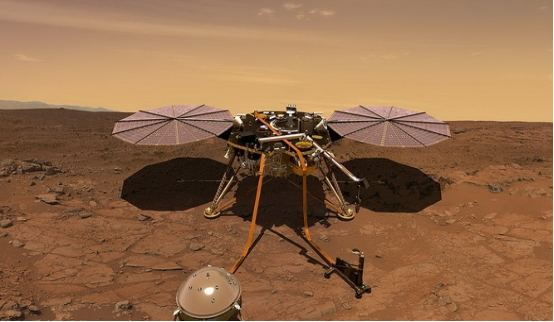
The Science of InSight: Probing the Martian Interior
The InSight (Interior Exploration using Seismic Investigations, Geodesy and Heat Transport) mission represents a monumental shift in how we study terrestrial planets. Unlike previous rovers that focused on surface geology, InSight was designed as a stationary geophysicist, peering deep into the crust, mantle, and core of Mars to understand how rocky planets evolve over billions of years.
The Objectives of Geophysical Exploration
At its core, the mission aimed to determine the size, thickness, and density of the Martian layers. By analyzing how seismic waves travel through the planet, scientists can infer the composition of the subsurface, effectively acting like a planetary ultrasound.

Seismology on the Red Planet: Detecting Marsquakes
Mars is not a geologically dead world. InSight utilized the SEIS (Seismic Experiment for Interior Structure) instrument to detect hundreds of seismic events, known as Marsquakes. These events provide critical data on the tectonic activity of the planet, which is significantly different from the plate tectonics observed on Earth.
Technical Comparison of Planetary Seismology
| Feature | Earth Seismology | Mars Seismology |
|---|---|---|
| Primary Driver | Plate Tectonics | Planetary Cooling/Contraction |
| Ambient Noise | High (Human/Oceanic) | Low (Wind/Atmospheric) |
| Instrument Sensitivity | Very High | Extremely High (Vacuum-sealed) |

Thermal Analysis and Heat Flow Experiments
Understanding the internal heat of Mars is essential for determining its history of volcanic activity. The HP3 instrument, often called the “Mole,” was designed to burrow deep into the Martian regolith to measure the heat escaping from the planet’s interior. Despite operational challenges in the dusty, complex soil of Elysium Planitia, the data gathered provides a baseline for planetary thermal modeling.
Key Insights into Martian Regolith
- Thermal Conductivity: The soil density affects heat dissipation rates.
- Subsurface Composition: Variations in material impact the penetration depth of thermal probes.
- Atmospheric Interaction: Surface temperatures fluctuate wildly, necessitating deep-drilling for accurate readings.

The Future of Planetary Geophysical Research
The legacy of InSight extends far beyond the data collected during its operational lifespan. It has established a blueprint for future missions to icy moons like Europa or Enceladus, where understanding the internal structure is key to identifying potential habitats for life. The techniques refined during this mission—such as remote seismic monitoring in harsh environments—are now industry standards for deep-space exploration.
Frequently Asked Questions (FAQ)
- What is a Marsquake and how does it differ from an earthquake?
- A Marsquake is a seismic event caused by the cooling and contraction of the planet’s crust, rather than the movement of tectonic plates seen on Earth.
- Why was the InSight mission stationary?
- Stationary placement allowed the lander to deploy sensitive instruments like the seismometer directly onto the ground, minimizing interference from the rover’s own movement.
- Did InSight find evidence of life?
- InSight was not designed to detect biological life directly; its goal was to characterize the geological and geophysical environment to understand if Mars could have supported life in the past.
- What was the most challenging part of the mission?
- The primary challenge was the “Mole” (HP3) instrument, which struggled to gain enough friction in the specific type of Martian soil to burrow to the required depth.