Astrophotography, the art of capturing images of the night sky and celestial objects, has undergone a breathtaking transformation over the past five decades. What was once a highly specialized and prohibitively expensive field, reserved for professional astronomers with access to massive observatories, has blossomed into an accessible and vibrant hobby for enthusiasts worldwide. This evolution is a story of technological leaps, from the painstaking process of film photography to the instantaneous feedback of digital sensors and the sophisticated power of processing software. This guide explores this remarkable journey, detailing the key innovations that have redefined our ability to photograph the cosmos and providing insights into the techniques that produce today’s award-winning images.
We will delve into the critical shift from analog to digital, the development of specialized cameras and software, and how these advancements have democratized the practice. Furthermore, we will analyze a real-world example of modern astrophotography excellence—an award-winning image of an annular solar eclipse—to illustrate how technology, skill, and artistic vision converge to create awe-inspiring results. This comprehensive overview serves as both a historical record and a practical guide for anyone looking to understand or participate in the art of capturing the universe.
The Technological Revolution in Astrophotography
The single most significant change in astrophotography over the last 50 years has been the transition from analog film to digital sensors. This was not merely a change in medium but a fundamental paradigm shift that unlocked unprecedented levels of detail, sensitivity, and efficiency. Understanding this technological leap is key to appreciating the quality of celestial images we see today.
From Film to Digital: The CCD and CMOS Sensor Era
In the era of film, astrophotography was an exercise in patience and uncertainty. Photographers would spend hours on a single long exposure, often using techniques like “hypersensitizing” film to increase its light sensitivity. Results were not visible until the film was developed, a process that could reveal tracking errors, focus issues, or other flaws, forcing the photographer to start over. The introduction of Charge-Coupled Devices (CCDs) and later Complementary Metal-Oxide-Semiconductor (CMOS) sensors changed everything.
- Increased Quantum Efficiency: Digital sensors are vastly more efficient at converting photons (light particles) into an electrical signal than film. While photographic film might capture only 1-2% of the light that hits it, modern CMOS sensors can achieve quantum efficiencies of over 80%, meaning they capture a much stronger signal in a shorter amount of time.
- Linear Response: Digital sensors have a linear response to light, meaning that doubling the exposure time doubles the signal strength. This makes data calibration and processing far more predictable and accurate than with film’s non-linear chemical reactions.
- Instant Feedback: The ability to see an image on a screen moments after it’s captured allows for immediate adjustments to focus, framing, and exposure settings, dramatically improving the workflow and success rate.
The Software Advantage: Stacking, Tracking, and Processing
Concurrent with the hardware revolution was the development of sophisticated software designed specifically for astrophotography. This software addressed the inherent challenges of capturing faint objects through a turbulent atmosphere. Instead of relying on a single, perfect long exposure, the modern technique involves capturing hundreds or even thousands of shorter exposures. These individual frames are then processed using specialized software.
This process, known as image stacking, aligns the images and averages out random noise, such as atmospheric distortion and sensor noise. The result is a final composite image with a much higher signal-to-noise ratio (SNR) than could ever be achieved with a single exposure. Software also automates tasks like guiding the telescope mount for perfect tracking of celestial objects, calibrating images with dark and flat frames, and advanced post-processing to bring out faint details and correct colors.

Mastering Modern Astrophotography Techniques
The evolution of technology has given rise to new techniques and workflows that are now standard practice for achieving professional-quality results. Mastering these techniques requires a blend of technical knowledge, meticulous planning, and artistic post-processing skills. The accessibility of powerful equipment has lowered the barrier to entry, but dedication to the craft remains paramount.
Essential Equipment for Today’s Astrophotographer
While you can start with a basic DSLR and a tripod, serious deep-sky astrophotography relies on a more specialized setup. The core components have become more refined and user-friendly over the years.
- Telescope/Lens: The choice of optic depends on the target. Wide-field refractors are excellent for nebulae, while long-focal-length Schmidt-Cassegrains or Ritchey-Chrétiens are ideal for galaxies and planets.
- Equatorial Mount: Perhaps the most critical piece of equipment, a sturdy, computer-controlled equatorial mount is necessary to track the apparent motion of the stars with high precision during long exposures.
- Dedicated Astronomy Camera: While DSLRs are versatile, dedicated astronomy cameras (often with cooling systems to reduce sensor noise) offer superior sensitivity and control for capturing faint deep-sky objects.
- Filters: Narrowband filters that isolate specific wavelengths of light (like Hydrogen-alpha, Oxygen-III, and Sulphur-II) allow photographers to cut through light pollution and capture stunning, detailed images of emission nebulae, even from urban areas.
Planning and Execution: The Key to a Great Shot
A successful astrophotography session begins long before the equipment is set up. Modern tools have made planning more precise than ever. Apps and software can predict weather, atmospheric seeing conditions, moon phases, and the precise location of celestial objects at any given time. Execution in the field requires meticulous attention to detail, including polar alignment of the mount, achieving perfect focus, and programming the imaging sequence.

A Case Study in Excellence: The Award-Winning ‘Ring of Fire’
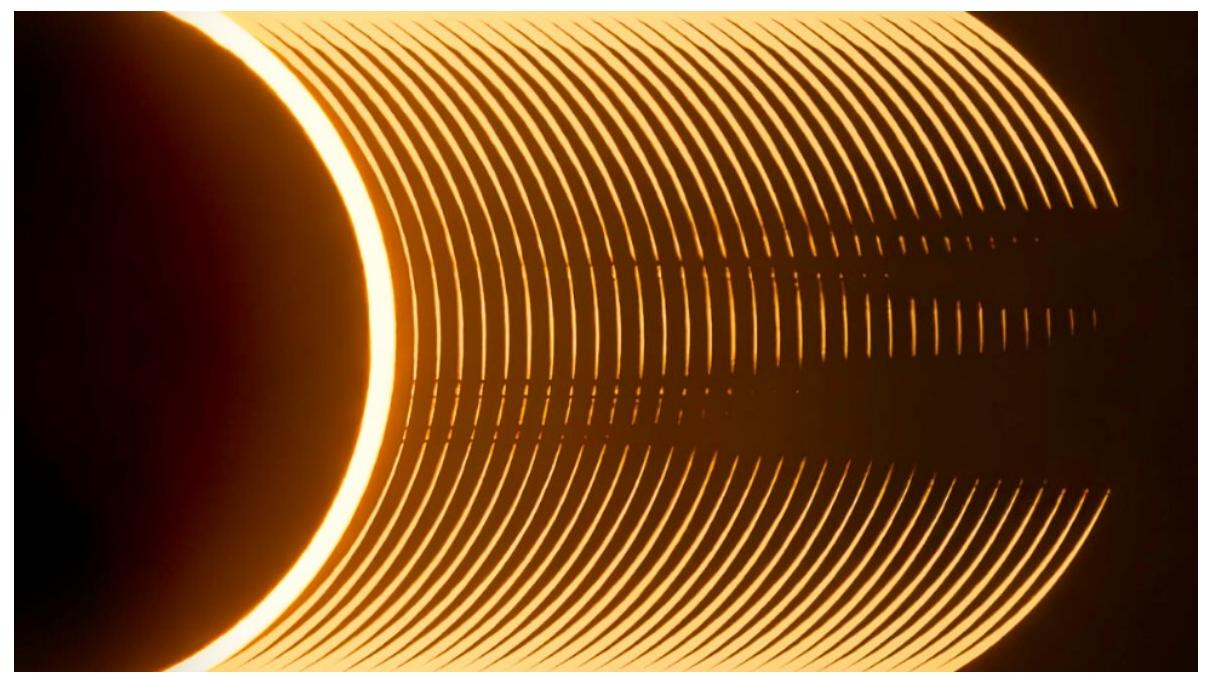
To see how modern technology and technique converge, we can examine a real-world masterpiece. Photographer Wei Zong’s image of an annular solar eclipse, which won the “Our Sun” category in the prestigious Royal Observatory Greenwich’s Astronomy Photographer of the Year competition, is a perfect example. This image, titled “The Ring of Fire,” showcases not only a spectacular celestial event but also the immense skill and preparation required to capture it.
The Photographer and the Vision
Wei Zong captured this remarkable photograph from Tibet, a location chosen for its high altitude and clear skies, which are crucial for minimizing atmospheric distortion. The image depicts the annular solar eclipse that occurred on June 21, 2020. An annular eclipse happens when the Moon is at its farthest point from Earth in its orbit, appearing slightly smaller in the sky. As a result, it doesn’t completely block the Sun, leaving a brilliant, fiery ring—the “annulus”—visible around the Moon’s silhouette.
Technical Breakdown: Equipment and Settings
Capturing such an event requires precise equipment and settings to manage the extreme dynamic range of the scene. The photographer utilized a Sony α7R IV camera paired with a FE 100-400mm f/4.5-5.6 GM OSS lens. The final shot was a composite, blending a long exposure to capture the ethereal solar corona and prominences with a shorter exposure to properly render the bright ring of the sun’s photosphere. This technique, made possible by digital processing, allows for detail to be preserved in both the brightest and dimmest parts of the scene—something impossible to achieve on a single piece of film.
The Significance of the Shot
The judges of the competition praised the image for its beauty and technical prowess. Judge László Francsics noted its “eerie and beautiful” quality, highlighting how it felt both serene and powerful. The photograph is a testament to how far astrophotography has come. It combines meticulous planning (traveling to a remote location), advanced digital camera technology (high-resolution sensor), and sophisticated post-processing techniques (blending exposures) to create an image that is both scientifically informative and artistically profound.

The Future of Capturing the Cosmos
The evolution of astrophotography is far from over. The trends that have brought us to this point—more sensitive sensors, smarter software, and increased accessibility—are set to continue, pushing the boundaries of what is possible for both amateur and professional imagers.
Advanced Sensor Technology and AI Processing
Camera manufacturers continue to develop sensors with even higher quantum efficiency, lower read noise, and larger formats. This will enable the capture of even fainter details with greater clarity. The next major leap, however, is likely to be driven by Artificial Intelligence (AI). AI-powered software is already emerging that can dramatically improve processes like noise reduction, sharpening (deconvolution), and even removing satellite trails from images. As these tools become more sophisticated, they will further streamline the post-processing workflow and allow photographers to extract more information than ever from their data.
Increased Collaboration and Remote Observatories
The internet has enabled a new era of collaborative astronomy. Amateur astrophotographers from around the world can now pool their data on a single object, captured over many nights, to create incredibly deep and detailed final images. Furthermore, the rise of affordable, internet-connected remote observatories allows enthusiasts to rent time on high-end telescopes located in pristine dark-sky locations, capturing data that would be impossible from their own backyards. This trend will continue to blur the lines between amateur and professional astronomy, leading to more scientific discoveries and breathtaking cosmic portraits.
Frequently Asked Questions (FAQ)
- What was the biggest challenge in astrophotography before digital cameras?
- The biggest challenge was the lack of immediate feedback combined with the low sensitivity of film. Photographers had to perform very long exposures (sometimes for hours) without knowing if their focus was sharp, if their tracking was accurate, or if the exposure was correct. Any mistake would only be discovered after developing the film, often hours or days later, wasting an entire night’s work.
- What is ‘image stacking’ and why is it so important?
- Image stacking is the core process of modern digital astrophotography. It involves taking many short-exposure photos of the same object and then using software to align them and average them together. This process dramatically improves the signal-to-noise ratio (SNR). It averages out random noise from the camera sensor and atmosphere while reinforcing the constant signal from the celestial object, resulting in a much cleaner, smoother, and more detailed final image.
- Can I start astrophotography with just a DSLR camera and a tripod?
- Absolutely. You can start by capturing wide-field shots of the Milky Way, constellations, and meteor showers with a standard DSLR or mirrorless camera, a lens, and a sturdy tripod. This is a great way to learn the basics of manual camera settings, focusing at night, and long exposures. For capturing detailed images of faint objects like nebulae and galaxies, you will eventually need an equatorial mount to track the stars.
- What made the award-winning ‘Ring of Fire’ photo so special?
- The photo by Wei Zong was special for several reasons. It captured a rare and beautiful celestial event (an annular solar eclipse) from an ideal high-altitude location in Tibet. Technically, it was a masterful composite image, blending different exposures to show detail in the incredibly bright solar ring as well as the much fainter solar corona. This technical skill, combined with the powerful and serene composition, made it a standout winner.
- How is AI changing astrophotography?
- AI is beginning to revolutionize the post-processing stage of astrophotography. New AI-powered tools can perform complex tasks with incredible efficiency. This includes intelligent noise reduction that preserves detail, deconvolution algorithms that sharpen images by correcting for atmospheric blur, and even tools that can remove unwanted artifacts like satellite trails or separate stars from nebulae to allow for independent processing. This allows photographers to achieve better results more quickly.