Introduction to Cosmic Nebulae: The Tapestry of the Universe
The night sky is far more than a vast, empty vacuum punctuated by isolated stars. It is a dynamic, ever-evolving canvas filled with colossal clouds of gas and dust known as nebulae. These magnificent cosmic structures are the fundamental building blocks of the universe, serving as both the birthplaces of new star systems and the breathtaking remnants of dying ones. Understanding nebulae is essential to grasping the grand narrative of cosmic evolution, as they represent the physical mechanisms through which matter is recycled across billions of years.
Historically, early astronomers used the term “nebula” (Latin for “cloud”) to describe almost any diffuse, glowing object in the sky, including galaxies like Andromeda. However, modern astrophysics has refined this definition. Today, nebulae are understood as distinct interstellar clouds of dust, hydrogen, helium, and other ionized gases. They are categorized based on their visual properties, their physical composition, and their role in the stellar lifecycle. This comprehensive guide will dissect the four most critical types of nebulae: molecular clouds, dark nebulae, reflection nebulae, and planetary nebulae, revealing the profound physics and stunning aesthetics that define our universe.
The Interstellar Medium (ISM) Connection
To fully appreciate nebulae, one must first understand the Interstellar Medium (ISM). The ISM is the matter and radiation that exists in the space between the star systems in a galaxy. Nebulae are essentially localized, high-density regions of the ISM. While the average density of the ISM is incredibly sparse—often just a few atoms per cubic centimeter—the gravitational accumulation of this material over eons creates the massive, dense clouds we observe as nebulae. This delicate balance between gravitational collapse and thermal expansion is the driving force behind the formation and morphology of these celestial clouds.

Molecular Clouds: The Ultimate Stellar Nurseries
Of all the structures in the cosmos, molecular clouds are arguably the most consequential. These monumental aggregations of gas and dust are the exclusive sites of star formation in the universe. Without molecular clouds, the universe would be a dark, stagnant void devoid of new stars, planetary systems, and ultimately, life itself. They are characterized by their immense size, staggering mass, and incredibly frigid temperatures, which create the perfect thermodynamic conditions for stellar gestation.
Molecular clouds are primarily composed of hydrogen molecules (H2), distinguishing them from other interstellar regions where hydrogen exists primarily in atomic or ionized forms. Because molecular hydrogen is difficult to detect directly using current astronomical instruments, researchers often trace these clouds using carbon monoxide (CO), which emits strongly at radio wavelengths and exists in a highly predictable ratio to hydrogen within these cold environments.
Physical Characteristics and Thermodynamics
The physical properties of molecular clouds are extreme by terrestrial standards. Understanding these parameters is crucial for comprehending how they function as stellar nurseries.
- Extreme Cold: The internal temperatures of molecular clouds hover between 10 and 30 Kelvin (roughly -263 to -243 degrees Celsius). This profound cold is absolutely necessary; if the gas were warmer, the thermal kinetic energy would cause the cloud to expand, preventing gravity from pulling the material together to form stars.
- Immense Mass: A single Giant Molecular Cloud (GMC) can contain anywhere from 10,000 to 10 million times the mass of our Sun. They can stretch across hundreds of light-years of interstellar space.
- High Density: While still a vacuum compared to Earth’s atmosphere, the density within a molecular cloud is significantly higher than the surrounding ISM, containing between 100 and 1,000,000 particles per cubic centimeter.

The Mechanics of Star Formation in Molecular Clouds
The transition from a cold, diffuse cloud of gas to a blazing, nuclear-fusing star is one of the most complex and fascinating processes in astrophysics. This metamorphosis is entirely dictated by the battle between gravity, which seeks to collapse the cloud, and internal pressures (thermal, magnetic, and turbulent), which resist this collapse. The process begins when an external trigger disrupts the cloud’s delicate equilibrium.
Triggers for collapse can include the shockwave from a nearby supernova explosion, collisions between two molecular clouds, or the density waves moving through the spiral arms of a galaxy. Once triggered, the densest regions of the cloud, known as “cores,” begin to succumb to their own gravity. As the material falls inward, it conserves angular momentum, causing the collapsing core to spin faster and flatten into a protoplanetary disk.
From Protostar to Main Sequence
The journey of a stellar embryo involves several distinct, highly dynamic phases that occur deep within the obscuring dust of the molecular cloud.
- The Protostellar Phase: As matter continues to accrete onto the central core, the temperature and pressure rise dramatically. However, at this stage, the object is a protostar; it generates heat through gravitational contraction rather than nuclear fusion.
- Bipolar Outflows: During accretion, powerful magnetic fields channel excess material toward the protostar’s poles, blasting it outward in spectacular bipolar jets. These jets carve vast cavities in the surrounding molecular cloud, eventually halting the accretion process.
- Ignition: Once the core temperature reaches approximately 10 million Kelvin, hydrogen nuclei begin to fuse into helium. The resulting outward radiation pressure halts gravitational collapse, and a new main-sequence star is officially born.

Dark Nebulae: The Mysterious Silhouettes of the Cosmos
While many nebulae are celebrated for their brilliant, glowing colors, dark nebulae command attention through their profound absence of light. These are regions of the interstellar medium so incredibly dense with cosmic dust that they completely absorb and scatter the visible light from stars or luminous nebulae situated behind them. Appearing as ink-black voids or intricate silhouettes against the starry backdrop, dark nebulae are not empty spaces, but rather some of the most matter-rich environments in the galaxy.
Dark nebulae are actually a sub-category of molecular clouds. They represent the densest, coldest, and most opaque regions where star formation is either imminent or actively occurring hidden from visible-light telescopes. Famous examples include the Coalsack Nebula in the Southern Cross and the iconic Horsehead Nebula in the constellation of Orion. These structures visually demonstrate the immense power of microscopic dust particles to obscure objects millions of times their size.
The Phenomenon of Interstellar Extinction
The mechanism by which dark nebulae block light is known as interstellar extinction. This is not merely a process of blocking light like a solid wall, but rather a complex interaction between photons and sub-micrometer-sized dust grains.
When starlight enters a dark nebula, the microscopic dust grains absorb the visible and ultraviolet photons. The energy from these absorbed photons warms the dust grains slightly, causing them to re-emit the energy at much longer infrared and submillimeter wavelengths. Furthermore, the dust scatters shorter wavelengths of light (blue light) more efficiently than longer wavelengths (red light), a phenomenon known as interstellar reddening. Because visible light cannot penetrate these dense dust concentrations, astronomers must rely on infrared and radio telescopes to peer inside dark nebulae and observe the stellar embryos gestating within.

Composition and Visual Characteristics of Dark Clouds
To fully grasp the nature of dark nebulae, one must look closely at their microscopic composition. The term “dust” in an astronomical context is vastly different from the household dust found on Earth. Cosmic dust grains are incredibly tiny—typically a fraction of a micron across, smaller than the particles in cigarette smoke. Despite making up only about 1% of the mass of a dark nebula (with the remaining 99% being gas, predominantly molecular hydrogen), this dust is entirely responsible for the nebula’s visual opacity.
These dust grains are primarily composed of silicates, carbon compounds (graphite), and ices. In the deep freeze of a dark nebula, volatile elements like water, ammonia, and carbon monoxide freeze onto the surfaces of these refractory dust grains, forming thick icy mantles. These icy mantles are crucial for cosmic chemistry; they act as microscopic laboratories where complex organic molecules—the potential precursors to life—are synthesized under the bombardment of cosmic rays.
Morphological Classifications of Dark Nebulae
Dark nebulae do not come in a single, uniform shape. They exhibit a wide range of morphologies, heavily influenced by the surrounding interstellar environment, magnetic fields, and gravitational forces.
- Bok Globules: Named after astronomer Bart Bok, these are small, isolated, and highly compact dark nebulae. They typically contain 10 to 50 solar masses of material and are actively collapsing to form single or binary star systems.
- Filamentary Structures: Many dark clouds appear as long, thread-like filaments stretching across the sky. These structures are often shaped by the galaxy’s magnetic fields and the turbulent flows of the interstellar medium.
- Infrared Dark Clouds (IRDCs): These are massive, dense regions that appear dark even against the bright infrared emission of the galactic plane. They are believed to be the precursors to massive star clusters.

Reflection Nebulae: The Cosmic Mirrors of Starlight
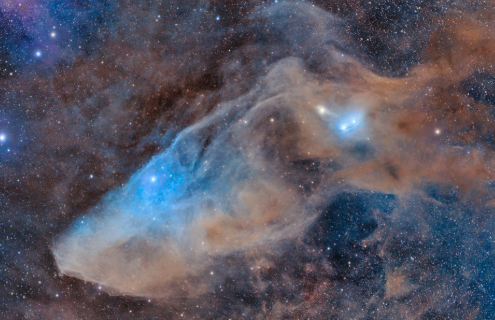
In stark contrast to the light-absorbing dark nebulae, reflection nebulae are breathtaking displays of scattered starlight. These nebulae do not emit their own visible light; instead, they act as magnificent cosmic mirrors, reflecting and scattering the light of nearby stars. The stars illuminating a reflection nebula are typically not hot enough to ionize the surrounding gas (which would create an emission nebula), but they are luminous enough to make the dust visible against the dark backdrop of space.
The most defining characteristic of a reflection nebula is its ethereal, ghostly blue color. This coloration is not due to the inherent color of the illuminating star or the chemical composition of the gas, but rather the physical properties of light scattering. One of the most famous and easily observable examples of a reflection nebula is the nebulosity surrounding the Pleiades star cluster, where the bright, hot B-type stars illuminate the surrounding interstellar dust through which the cluster is currently passing.
The Physics of Rayleigh Scattering
The beautiful blue hue of reflection nebulae is governed by the exact same physical principle that makes the Earth’s sky blue: Rayleigh scattering. This optical phenomenon occurs when light interacts with particles that are significantly smaller than the wavelength of the light itself.
When the broad spectrum of white light from a nearby star hits the microscopic dust grains in the nebula, the longer, red wavelengths of light tend to pass straight through the dust relatively unhindered. However, the shorter, blue wavelengths of light crash into the dust grains and are scattered in all directions. Because this blue light is bounced around and redirected toward the observer on Earth, the entire cloud appears to glow with a brilliant blue luminescence. If the illuminating star is exceptionally red (such as a red supergiant), the reflection nebula may appear yellowish or red, but the vast majority are illuminated by hot, blue-white stars.

The Interplay of Light and Dust in Reflection Nebulae
The study of reflection nebulae provides astronomers with an invaluable laboratory for understanding the precise nature of interstellar dust. By analyzing the exact spectrum of the reflected light and comparing it to the spectrum of the illuminating star, scientists can deduce the size, shape, and composition of the dust grains within the nebula. This interplay between light and matter is a cornerstone of modern observational astrophysics.
One of the critical measurements taken from reflection nebulae is the “albedo” of the cosmic dust. Albedo is a measure of reflectivity; it indicates what percentage of the incoming starlight is scattered versus how much is absorbed. Interstellar dust typically has a high albedo in the visible spectrum, which is why reflection nebulae can appear so bright. Furthermore, the light coming from reflection nebulae is often highly polarized. As the light waves scatter off the elongated, magnetically aligned dust grains, the light waves become oriented in specific directions, providing a map of the magnetic fields threading through the nebula.
Key Features of Reflection Nebulae
To differentiate reflection nebulae from other cosmic structures, astronomers look for specific optical signatures and environmental conditions.
- Proximity to Illuminating Stars: A reflection nebula must have a nearby light source. The brightness of the nebula fades rapidly as the distance from the illuminating star increases, following the inverse-square law of light.
- Spectral Similarity: The optical spectrum of a reflection nebula is essentially a perfect replica of the spectrum of the star illuminating it, albeit shifted toward the blue end due to scattering. There are no bright emission lines from ionized gases.
- Association with Star Formation: Reflection nebulae are frequently found in the same giant molecular cloud complexes as dark nebulae and emission nebulae, highlighting regions where new stars have recently cleared away some, but not all, of their natal dust cocoons.

Planetary Nebulae: The Spectacular Finale of Stellar Evolution
While molecular, dark, and reflection nebulae are intimately tied to the birth and early life of stars, planetary nebulae represent the spectacular, beautiful, and violent end of a star’s lifecycle. Despite their name, planetary nebulae have absolutely nothing to do with planets. The term is a historical misnomer originating in the 18th century, primarily attributed to astronomer William Herschel. Through early, low-resolution telescopes, these glowing, spherical shells of gas resembled the pale, round disks of the planets Uranus and Neptune.
A planetary nebula forms when an intermediate-mass star (roughly 0.8 to 8 times the mass of our Sun) exhausts its nuclear fuel. In its final throes, the star expands into a red giant, its core contracting and heating up while its outer layers become bloated and unstable. Through a series of violent thermal pulses, the star physically ejects its outer envelope into space. The exposed core, now a blistering-hot white dwarf, emits intense ultraviolet radiation that ionizes the expanding shell of ejected gas, causing it to glow brilliantly in a myriad of colors.
The Chemical Enrichment of the Universe
Planetary nebulae are not just visually stunning; they are critical engines of cosmic chemistry. Throughout its life, the parent star fused hydrogen and helium into heavier elements like carbon, nitrogen, and oxygen deep within its core. When the star sheds its outer layers to form the planetary nebula, these newly forged elements are expelled into the surrounding interstellar medium.
This process of stellar nucleosynthesis and subsequent expulsion is responsible for seeding the galaxy with the heavy elements necessary for the formation of subsequent generations of stars, rocky planets, and biological life. Without the death throes of stars encapsulated in planetary nebulae, the universe would remain a sterile expanse of primordial hydrogen and helium. The colorful glows of these nebulae are actually specific emission lines from these elements: glowing red for hydrogen and nitrogen, and brilliant blue-green for doubly ionized oxygen.

Structural Complexity and Lifespan of Planetary Nebulae
One of the most fascinating aspects of planetary nebulae is their staggering morphological diversity. Very few planetary nebulae are perfectly spherical. Instead, they exhibit an astonishing array of complex, symmetrical shapes, ranging from hourglasses and butterflies to intricate spirals and overlapping rings. The Helix Nebula and the Ring Nebula are prime examples of this structural complexity.
Astronomers believe this diversity is driven by the dynamic environment surrounding the dying star. If the dying star is part of a binary star system, the gravitational pull of the companion star can shape the outflowing gas into bipolar lobes. Additionally, strong magnetic fields generated by the spinning white dwarf core can collimate the ejected material into powerful jets, carving complex cavities into the expanding gas shell. Fast stellar winds from the exposed core catch up to and crash into the slower-moving gas ejected earlier, creating dense rims and shockwaves that define the nebula’s intricate architecture.
A Fleeting Cosmic Phenomenon
In the grand timescale of the universe, planetary nebulae are incredibly short-lived phenomena. They are the cosmic equivalent of a fireworks display—brilliant, explosive, and quickly fading.
- Rapid Expansion: The gas shell of a planetary nebula expands outward at staggering speeds, typically between 20 and 50 kilometers per second.
- Short Lifespan: Because of this rapid expansion, the gas quickly disperses into the interstellar medium. Simultaneously, the central white dwarf cools down, and its ultraviolet output drops. As a result, a planetary nebula remains visible for only about 10,000 to 20,000 years before fading into obscurity.
- The White Dwarf Remnant: Long after the glowing gas has dissipated, the central white dwarf remains. It will spend the next several billion years slowly cooling and fading, a quiet monument to the spectacular nebula it once powered.

Comparative Analysis of Nebula Types
To truly synthesize our understanding of cosmic nebulae, it is highly beneficial to compare their defining characteristics side-by-side. While they all consist of interstellar gas and dust, their temperatures, densities, and roles in the stellar lifecycle vary drastically. The following table provides a clear, multi-dimensional comparison of the four primary types of nebulae discussed in this guide.
By contrasting these structures, we can clearly trace the lifecycle of matter in the galaxy. Matter begins in the cold, dark recesses of molecular and dark nebulae, is illuminated briefly as reflection nebulae during stellar infancy, and is eventually violently expelled back into the void as planetary nebulae to begin the cycle anew.
| Nebula Type | Primary Composition | Temperature | Role in Stellar Lifecycle | Visual Characteristic |
|---|---|---|---|---|
| Molecular Cloud | Molecular Hydrogen (H2), CO, Dust | 10 – 30 Kelvin | Primary site of star formation. | Vast, cold, largely invisible in optical light. |
| Dark Nebula | Dense Dust, Gas, Ices | 10 – 20 Kelvin | Dense cores collapsing into protostars. | Opaque, black silhouettes blocking background light. |
| Reflection Nebula | Interstellar Dust, Gas | Variable (warmed by stars) | Surrounds newly formed or passing stars. | Glowing blue haze due to Rayleigh scattering. |
| Planetary Nebula | Ionized Gas (H, He, O, N) | 10,000+ Kelvin (Gas) | The death throes of low-to-intermediate mass stars. | Bright, colorful, complex symmetrical shells. |
