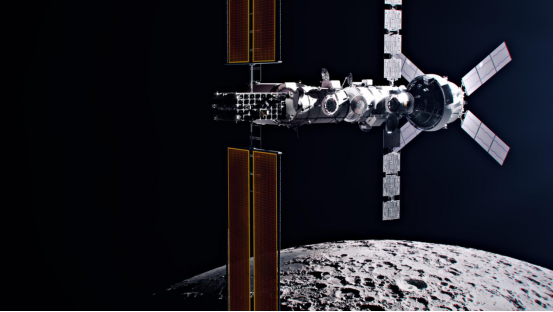
Gateway’s overall concept and mission
The Gateway, a lunar orbital space station, is a small international space station orbiting the Moon, designed to provide long-term support for deep space exploration. Gateway not only serves as a resupply and transit platform for manned lunar missions and Mars outpost exploration, but also functions as a scientific research and technology verification center. Through long-term deployments in lunar orbit, Gateway can test life support systems, propulsion technologies, and long-term radiation protection measures in deep space environments, laying a solid foundation for future deep space missions. Its construction embodies the spirit of international cooperation and is a crucial strategic milestone for humanity’s journey beyond low Earth orbit into deep space.
Core areas of scientific research
Gateway’s scientific mission covers multiple cutting-edge research fields, including lunar environmental science, Earth-Moon system dynamics, deep space object observation, and microgravity experiments. Through high-precision remote sensing and laser ranging in lunar orbit, Gateway can provide data support for lunar topographic mapping, mineral distribution, and the detection of permanently shadowed regions. Lunar orbit observations can supplement the blind spots of ground-based probes, providing crucial information on the distribution of water ice resources in lunar polar regions, geological evolution history, and impact crater formation mechanisms. Furthermore, the microgravity experiment module within the space station can conduct biomedical, materials science, and fluid dynamics research, providing scientific evidence for long-term deep space life.
Deep Space Life Support System Experiment
Gateway provides a testing platform for life support systems in deep space environments, including air circulation, water circulation, and waste recovery systems. Long-term residency experiments can verify the stability and sustainability of life support systems in microgravity and high-radiation environments. By simulating the living environment of Mars missions or long-term lunar missions, scientists can evaluate astronaut health monitoring, radiation protection, and psychological adaptation strategies. These experiments provide crucial data for future manned Mars exploration and empirical evidence for the design and sustainable operation of deep spacecraft.
High-precision remote sensing and Earth-Moon science research
Gateway’s highly flexible lunar orbit enables multi-angle, multi-band remote sensing observations. High-resolution imaging and spectral analysis can precisely determine the lunar surface mineral composition, thermal properties, and topographic evolution. Laser ranging equipment can be used for precise lunar orbital positioning, monitoring lunar orbital changes and tidal effects. These studies not only enhance our understanding of lunar geology and dynamics but also provide a scientific basis for future lunar base site selection, resource exploration, and surface facility layout. Long-term data accumulation will help establish an evolutionary model of the Earth-Moon system, providing a comparative reference for planetary and Earth sciences.
Deep Space Observation Platform
The Gateway, orbiting the Moon, offers a unique perspective for deep-space object observation. Far from Earth’s atmosphere and radio interference, it provides greater sensitivity for low-frequency radio, ultraviolet, and infrared observations. Astronomers can use the Gateway to observe early star formation, exoplanet atmospheres, and the interaction between the solar wind and planetary magnetic fields. As a relay platform, the space station can also support the coordinated operation of lunar surface observatories and Earth-based observation networks, expanding the spatial and temporal coverage of astronomical observations and providing crucial data for cosmology and planetary science.
International cooperation and strategic significance
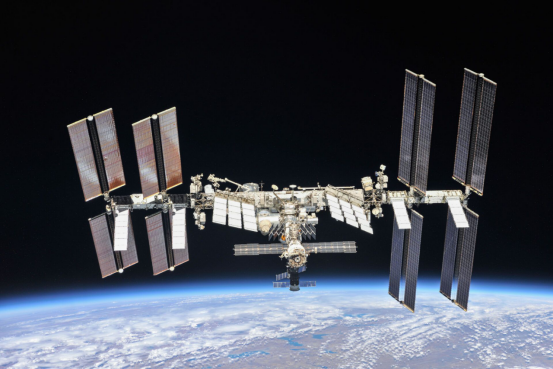
The Gateway project brings together multiple international space agencies, including NASA, ESA, JAXA, and CSA, to advance deep space exploration through resource sharing and technological complementarity. International cooperation not only reduces costs and technological risks but also promotes standardization, equipment compatibility, and the accumulation of operational experience in global deep space exploration. Strategically, Gateway provides cutting-edge support for lunar resource development, deep space communication network construction, and Mars mission transit, enabling long-term sustainable operations in lunar and Mars exploration and strengthening the scientific and political value of international space cooperation.
Lunar orbital transfer and mission support
As a lunar transit station, Gateway can support a variety of manned and unmanned missions. Astronauts can use the space station for transit, resupply, maintenance, and experimental operations, reducing the risks of long-distance deep space flights. Unmanned probes can use Gateway for orbital maneuvers, data relay, and refueling, improving mission flexibility and scalability. This space transit capability makes lunar surface exploration, Mars mission preparation, and the construction of deep space station networks more efficient, providing infrastructure support for future large-scale deep space exploration.
Technology verification and future mission test field
Gateway serves not only as a scientific platform but also as a technology validation and testing ground. New propulsion technologies, automated equipment, remote operating systems, and space robots can all be validated and optimized at Gateway. Through long-term residency experiments, scientists can assess equipment durability, operational efficiency, and emergency response capabilities, accumulating experience for future long-duration deep space missions. This technology validation is of great significance, providing empirical support for reducing risks and improving mission success rates, while also driving the development of space technology and enhancing deep space exploration capabilities.
The role of promoting the utilization of lunar resources
Gateway’s unique location in lunar orbit helps assess the potential for lunar resource utilization. Remote sensing observations and data analysis of water ice in permanently shadowed regions of the lunar poles can provide a scientific basis for future in-situ resource utilization. Water ice extraction can be used for life support, fuel production, and long-term mission support, forming a sustainable lunar exploration model. As a data and technology hub, Gateway provides comprehensive support for lunar resource exploration, experimentation, and infrastructure construction, promoting feasibility studies for long-term human habitation and development on the Moon.
Education and Public Impact
The Gateway project has significant educational and public communication value. Through a visualized data platform, interactive simulations, and educational activities, the public can gain a direct understanding of deep space exploration, lunar orbital science, and international cooperation practices. The educational program can be integrated with physics, astronomy, and engineering courses to cultivate students’ interest in deep space exploration and aerospace science. Public participation and science popularization contribute to improving global scientific literacy, enhancing public awareness of international cooperation, and providing social support for the long-term development of deep space exploration projects.
Summary and Scientific Strategic Implications
The Gateway lunar orbital space station serves as a crucial node in deep space exploration, integrating scientific research, technology verification, mission transit, and resource assessment. It provides an experimental platform for lunar geology, deep space astronomy, life support, and space technology, laying the foundation for future missions to Mars and beyond. Its international cooperation model and long-term strategic layout make Gateway not only a scientific facility but also a core hub for deep space exploration. Through long-term observation, experimentation, and technology verification, Gateway will drive substantial progress in the scientific frontiers of lunar and deep space exploration, providing a solid foundation for future interplanetary exploration.