The universe is an immense tapestry woven with billions of galaxies, each a unique cosmic island teeming with stars, gas, dust, and dark matter. These colossal structures are the fundamental building blocks of the cosmos, housing everything from tiny dwarf galaxies to super-giant ellipticals stretching millions of light-years across. Understanding galaxies is central to comprehending the universe’s evolution, the distribution of matter, and ultimately, our place within this grand cosmic ballet. This guide will take you on an in-depth tour of the most fascinating galaxies, exploring their diverse forms, remarkable features, and the dynamic processes that shape their destinies.
From the majestic spiral arms that host vibrant star-forming regions to the ancient, spherical halos of elliptical galaxies, each type offers clues to the universe’s past and future. We will delve into specific examples, uncovering the secrets of our galactic neighbors and venturing billions of light-years away to witness phenomena that defy imagination. Prepare to explore the swirling beauty of the Pinwheel, the dramatic collision course of Andromeda, the mysterious void of the Black Eye, and the sheer scale of cosmic behemoths like IC 1101. This journey will illuminate not just the individual wonders of these galaxies but also the overarching principles of galactic formation, interaction, and the ongoing quest to map the cosmic web.
Understanding Galaxy Types: A Cosmic Classification
Galaxies are broadly classified into several main types based on their visual morphology, a system largely pioneered by Edwin Hubble. This classification helps astronomers understand their evolutionary paths and the physical processes that govern their structure. While diverse, these categories provide a framework for comprehending the vast galactic landscape.
Spiral Galaxies: Majestic Pinwheels of Stars
Spiral galaxies are perhaps the most iconic, characterized by a flattened, rotating disk containing stars, gas, and dust, and a central bulge of older stars. From the bulge, spiral arms extend outward, often giving these galaxies a beautiful, pinwheel-like appearance. These arms are regions of active star formation, appearing brighter due to the presence of young, hot, blue stars. The Milky Way, our home galaxy, is a barred spiral galaxy, a subtype where the central bulge has an elongated, bar-shaped structure.
- Pinwheel Galaxy (M101): A classic example of a grand-design spiral galaxy, M101 is located in the constellation Ursa Major, approximately 21 million light-years away. It boasts at least a trillion stars and exhibits prominent, well-defined spiral arms, rich in star-forming nebulae. Its vast size, with a diameter of about 170,000 light-years, makes it one of the largest and most luminous disk galaxies in the local universe.
- Triangulum Galaxy (M33): As the third-largest member of our Local Group (after Andromeda and the Milky Way), M33 is a face-on spiral galaxy about 3 million light-years away. It’s a treasure trove for astronomers studying star formation, containing numerous massive star-forming regions, including NGC 604, one of the largest known H II regions. Its relatively close proximity and orientation allow for detailed studies of its structure and stellar populations.
- Sunflower Galaxy (M63): Also known as NGC 5055, M63 is a flocculent spiral galaxy located about 27 million light-years away in the constellation Canes Venatici. Its name comes from the numerous, tightly wound, short spiral arm segments that give it a flower-like appearance. This galaxy is known for its intense star formation activity and is part of the M51 Group of galaxies.
- UGC 2885 (Rubin’s Galaxy): This is an extraordinary example of a “lonely giant” spiral galaxy, one of the largest and most massive disk galaxies known, with a diameter of 463,000 light-years. Located about 232 million light-years away, it’s remarkably isolated, suggesting it grew to its immense size without significant mergers, primarily by accreting gas from the cosmic web. This makes it a crucial object for understanding galaxy growth in isolation.
Elliptical Galaxies: Spheres of Ancient Stars
Elliptical galaxies are generally spheroidal or ovoid in shape, ranging from nearly spherical (E0) to highly elongated (E7). They typically contain older, redder stars and very little cold gas and dust, indicating that star formation has largely ceased. These galaxies are often found in galaxy clusters and can be enormous, sometimes dwarfing spiral galaxies in terms of mass and number of stars.
- Centaurus A (NGC 5128): Located about 12 million light-years away, Centaurus A is a prominent elliptical galaxy and one of the closest active galaxies to Earth. It’s known for its distinctive dark dust lane, which is thought to be the remnant of a swallowed spiral galaxy. Centaurus A is a powerful radio source, emitting immense jets of plasma from its supermassive black hole, making it a key object for studying active galactic nuclei (AGN) and galaxy mergers.
- ESO 444-4640: This super elliptical galaxy, residing in the Abell 1060 cluster, is a stunning example of a massive, ancient galaxy. Located approximately 100 million light-years away, it hosts a staggering 27,000 globular star clusters, far more than the Milky Way’s few hundred. Its immense size and rich cluster population provide insights into the formation and evolution of the largest galaxies in dense environments.
- Hercules A (3C 348): An incredibly powerful radio galaxy, Hercules A is a super-giant elliptical galaxy located about 2.1 billion light-years away. It’s famous for its enormous jets of plasma, which stretch for over a million light-years and are energized by a central supermassive black hole billions of times the mass of our Sun. The sheer scale of its radio lobes makes it a spectacular example of extreme galactic activity.
- IC 1101: Arguably the largest known galaxy in the observable universe, IC 1101 is a supergiant elliptical galaxy at the center of the Abell 2029 galaxy cluster, located about 1.04 billion light-years away. With a diameter of up to 6 million light-years and an estimated 100 trillion stars, it dwarfs our Milky Way by a factor of 60 in size and 1000 in mass. Its immense size is likely the result of numerous mergers with smaller galaxies over cosmic time.
Irregular Galaxies: Cosmic Oddities
Irregular galaxies lack a distinct regular shape, often appearing chaotic or distorted. They are typically rich in gas and dust and exhibit vigorous star formation. Their irregular forms are often attributed to gravitational interactions with other galaxies or to internal processes that have disrupted a more organized structure.
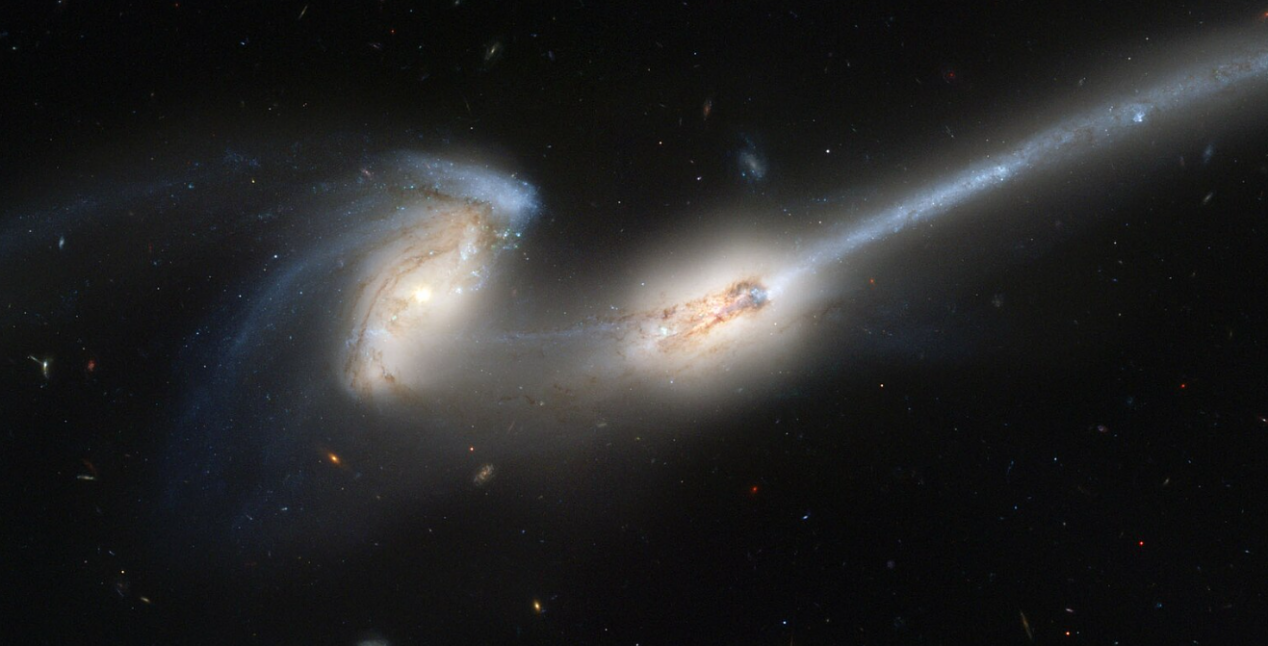
- Mouse Galaxy (NGC 4676): A pair of interacting spiral galaxies located approximately 300 million light-years away in the constellation Coma Berenices. Their elongated, tidal tails, caused by gravitational forces during their close encounter, resemble the tail of a mouse. This system is a classic example of galaxies in the early stages of a merger, providing a glimpse into the future collision of the Milky Way and Andromeda.
- Cartwheel Galaxy: Located about 500 million light-years away, the Cartwheel Galaxy is a spectacular example of a ring galaxy, a type of irregular galaxy formed by a high-speed head-on collision between a small galaxy and a larger disk galaxy. The collision created a shockwave that swept through the galaxy, compressing gas and triggering a wave of star formation in its outer ring, which spans about 150,000 light-years.
- Tadpole Galaxy (Arp 188): This disrupted barred spiral galaxy, located about 400 million light-years away, is named for its immense tail of stars, gas, and dust, stretching for 280,000 light-years. This tail is the direct result of a gravitational encounter with a smaller, more compact galaxy, which passed through the Tadpole and flung out its material. The tail is actively forming new stars, making it a vibrant laboratory for studying collision-induced star formation.
- Comet Galaxy (PGC 27147): Found in the Abell 2667 galaxy cluster, the Comet Galaxy is a spectacular example of a galaxy undergoing “ram-pressure stripping.” As it hurtles through the hot, dense gas in the cluster at 3.5 million km/h, the intergalactic medium strips away its gas and dust, creating a magnificent 600,000 light-year-long tail. This process effectively starves the galaxy of fuel for star formation, turning it into a red, passive galaxy.
- Vulture Galaxy: While not a formal classification, the term “Vulture Galaxy” could refer to a galaxy undergoing a dramatic stripping or interaction, similar to the Comet Galaxy. The dynamics of galaxies in clusters often lead to such predatory-like interactions where gas and stars are “devoured” or stripped away, significantly altering their morphology and star-forming capabilities. Such processes are crucial for understanding the evolution of galaxies in crowded environments.

Our Galactic Neighbors: Close Encounters and Future Collisions
Our cosmic neighborhood, the Local Group, is a collection of over 50 galaxies gravitationally bound together. Dominated by the two giants, the Milky Way and Andromeda, this group is a dynamic arena where galaxies interact, merge, and evolve. Studying these nearby galaxies provides invaluable insights into the processes that shape galactic structures across the universe.
The Andromeda Galaxy: Our Colliding Future
The Andromeda Galaxy (M31) is the largest galaxy in the Local Group and our closest large galactic neighbor, located approximately 2.5 million light-years away. It is a majestic barred spiral galaxy, even larger than the Milky Way, with an estimated trillion stars. Andromeda is currently hurtling towards our Milky Way at a speed of about 110 kilometers per second, setting the stage for a spectacular cosmic collision in roughly 4.5 billion years. This event will not be a head-on crash of stars, but rather a slow, gravitational dance that will eventually merge the two galaxies into a new, larger elliptical galaxy, often dubbed “Milkomeda” or “Milkdromeda.”
- Size and Structure: Andromeda spans approximately 220,000 light-years in diameter, more than twice the size of the Milky Way’s disk. It possesses a prominent central bulge and two main spiral arms, along with an extensive halo of globular clusters.
- Satellite Galaxies: Andromeda is orbited by numerous smaller satellite galaxies, including M32 and M110, which are interacting with its outer regions. These interactions provide clues about the gravitational dynamics within galaxy groups.
- Collision Dynamics: The impending merger with the Milky Way is driven by mutual gravitational attraction. While stars are unlikely to collide directly due to the vast distances between them, the gravitational forces will distort both galaxies, triggering intense bursts of star formation as gas clouds are compressed. The supermassive black holes at the centers of both galaxies are also expected to merge, releasing enormous amounts of energy.
The Triangulum Galaxy: A Satellite in the Making?
The Triangulum Galaxy (M33), as mentioned, is the third-largest member of the Local Group. It’s a relatively small, face-on spiral galaxy, making it an excellent target for observing its internal structure. There is ongoing debate among astronomers about its relationship with Andromeda and the Milky Way. Some evidence suggests that M33 may be a gravitationally bound satellite of Andromeda, while other studies indicate it might be on an independent trajectory, though still influenced by the larger galaxies. Its rich star-forming regions make it a vibrant example of a galaxy in full swing of stellar creation.
- Star Formation Hotbeds: M33 is particularly notable for its giant H II regions, like NGC 604, which are massive clouds of ionized hydrogen where new stars are being born at prodigious rates. These regions are significantly larger and more luminous than the Orion Nebula in our own galaxy.
- Low Metallicity: Studies of M33’s stellar populations show a lower metallicity (abundance of elements heavier than hydrogen and helium) compared to the Milky Way, suggesting a different chemical evolution history.

Galactic Interactions: Mergers, Tails, and Stripping
Galaxies rarely exist in isolation. Gravitational interactions, from minor tidal tugs to spectacular head-on collisions, are fundamental drivers of galactic evolution. These interactions can dramatically alter a galaxy’s structure, trigger starbursts, or even lead to the formation of entirely new galactic entities. The universe is a dynamic laboratory where these cosmic dances are constantly unfolding.
The Mouse Galaxy: A Dance Towards Merger
The Mouse Galaxy (NGC 4676) provides a vivid illustration of a galactic interaction in its early to mid-stages. This system comprises two spiral galaxies, NGC 4676A and NGC 4676B, which have already undergone a close gravitational encounter. The immense tidal forces exerted during this pass have drawn out spectacular, elongated tails of stars and gas, giving them their “mouse” moniker. These tidal tails are not just visually striking; they are also sites of intense star formation as the gas within them is compressed. Eventually, these two galaxies are destined to fully merge, likely forming a single, larger elliptical galaxy, demonstrating a common pathway for galaxy evolution.
- Tidal Forces: The gravitational pull from one galaxy stretches and distorts the other, drawing out material into long streams. These are known as tidal tails.
- Star Formation: The compression of gas within the interacting regions and tidal tails often triggers bursts of star formation, leading to bright blue knots of young stars.
- Future Evolution: Such interactions typically lead to the eventual merger of the galaxies, where their distinct structures are lost, and a new, often elliptical, galaxy forms.
The Black Eye Galaxy: A Mysterious Dark Lane
The Black Eye Galaxy (M64 or NGC 4826) presents a unique and intriguing case of galactic interaction or accretion. Located about 17 million light-years away, this spiral galaxy is famous for its spectacular dark band of absorbing dust in front of its bright nucleus, which gives it its “black eye” appearance. What makes M64 particularly fascinating is that its inner region of stars rotates in the opposite direction to its outer region of stars and gas. This counter-rotation is strong evidence of a past merger event, where M64 likely absorbed a smaller, gas-rich galaxy that was rotating in the opposite direction. The dark dust lane is believed to be the remnant of this swallowed galaxy, still settling into the larger structure.
- Counter-Rotation: The distinct and opposite rotational patterns of gas and stars within M64 are a direct signature of a past galactic merger or accretion event.
- Dust Lane: The prominent dark dust lane is a key feature, likely composed of material from the absorbed galaxy, obscuring the light from the central region.
- Ongoing Evolution: The galaxy is still in the process of settling down from this ancient merger, with new stars forming at the boundary between the counter-rotating gas flows.
The Tadpole and Comet Galaxies: Cosmic Stripping
While the Mouse Galaxy shows early merger stages, the Tadpole and Comet Galaxies illustrate another dramatic consequence of galactic interaction: stripping. The Tadpole Galaxy‘s spectacular 280,000 light-year tail of stars and gas is the direct result of a close encounter with a smaller, compact galaxy that passed through it. This gravitational “slingshot” effect pulled material out, creating the elongated structure. Similarly, the Comet Galaxy, speeding through the heart of the Abell 2667 cluster, is experiencing “ram-pressure stripping.” The intense pressure from the superheated intergalactic gas strips away its own gas and dust, forming a massive 600,000 light-year-long tail. Both cases demonstrate how external forces can dramatically reshape galaxies and influence their star-forming capabilities, often leading to the cessation of new star birth.
- Tidal Stripping (Tadpole): Gravitational forces from a passing galaxy pull material away, forming long tails.
- Ram-Pressure Stripping (Comet): High-speed movement through dense intra-cluster gas pushes gas and dust out of the galaxy, forming a trailing tail.
- Impact on Star Formation: Both processes remove the fuel for star formation, leading to a decline in new stellar birth within the affected galaxy.

Exploring Galactic Behemoths: The Largest and Most Extreme Galaxies
While our Milky Way is a respectable galaxy, the universe hosts true giants that defy imagination in their scale, mass, and energy output. These galactic behemoths push the boundaries of our understanding of galaxy formation and evolution, often harboring billions or even trillions of stars and supermassive black holes that power cosmic jets.
IC 1101: The Universe’s Largest Known Galaxy
At the pinnacle of galactic scale sits IC 1101, an elliptical galaxy located over a billion light-years away at the heart of the Abell 2029 galaxy cluster. This colossal entity holds the record for the largest known galaxy, with a staggering diameter that could reach up to 6 million light-years. To put this into perspective, our Milky Way is only about 100,000 light-years across. IC 1101 is estimated to contain up to 100 trillion stars, a thousand times more than our own galaxy. Its immense size is believed to be the cumulative result of countless mergers with smaller galaxies over billions of years, making it a “fossil record” of galactic cannibalism within a dense cluster environment. The study of IC 1101 provides crucial insights into the processes that lead to the growth of central cluster galaxies.
- Unprecedented Scale: Its diameter of up to 6 million light-years makes it an outlier in galactic size, challenging models of galaxy growth.
- Stellar Population: Home to an estimated 100 trillion stars, primarily older, redder stars, typical of giant elliptical galaxies where star formation has largely ceased.
- Cluster Dominance: Resides at the center of the rich Abell 2029 galaxy cluster, where it has likely grown by accreting and merging with numerous smaller galaxies.
Hercules A (3C 348): A Radio Powerhouse
Another extreme example is Hercules A, a supergiant elliptical galaxy that is also one of the brightest radio sources in the sky. Located approximately 2.1 billion light-years away, Hercules A is dominated by a central supermassive black hole with a mass billions of times that of the Sun. This black hole actively consumes surrounding matter, generating incredibly powerful jets of plasma that extend for over a million light-years into intergalactic space. These jets, visible at radio wavelengths, inflate vast lobes that are far larger than the galaxy itself. Hercules A serves as a prime example of an active galactic nucleus (AGN) and demonstrates the immense energy output possible from supermassive black holes at the centers of massive galaxies, influencing the distribution of gas and the formation of stars across vast cosmic distances.
- Active Galactic Nucleus (AGN): Powered by a supermassive black hole that is actively accreting matter, leading to extreme energy output.
- Colossal Radio Jets: Emits two opposing jets of highly energetic particles that extend millions of light-years, creating enormous radio lobes.
- Environmental Impact: The energy from these jets can heat and displace gas in the surrounding galaxy cluster, potentially suppressing star formation in nearby galaxies.
ESO 306-17 and A2261-BCG: Third and Fourth Largest Galaxies
Beyond IC 1101 and Hercules A, other galaxies stand out for their prodigious sizes. ESO 306-17 has been identified as potentially the fourth-largest galaxy in the universe. Similarly, A2261-BCG (Brightest Cluster Galaxy in Abell 2261) ranks as the third-largest. These are both massive elliptical galaxies found at the cores of dense galaxy clusters, which are prime locations for galaxies to grow to extreme sizes through mergers and accretion. These galaxies often possess incredibly diffuse stellar halos that extend far beyond their visible cores, hinting at their complex merger histories. The sheer number of stars, globular clusters, and dark matter within these galaxies makes them gravitational anchors in their respective clusters, influencing the dynamics of hundreds or thousands of other galaxies around them. Studying their properties helps astronomers understand the upper limits of galaxy growth and the role of environment in shaping galactic giants.
- Central Cluster Galaxies (BCGs): Both ESO 306-17 and A2261-BCG are central cluster galaxies, meaning they are the largest and most luminous galaxies at the heart of their respective galaxy clusters.
- Diffuse Halos: Characterized by extensive, faint outer halos of stars, indicative of a history of absorbing numerous smaller galaxies.
- Supermassive Black Holes: Expected to host some of the most massive supermassive black holes known, driving their immense gravitational influence.

The Cosmic Cigar (M82): A Starburst Galaxy
The Cigar Galaxy (M82), also known as NGC 3034, is a magnificent example of a starburst galaxy, where stars are forming at an extraordinarily high rate. Located about 12 million light-years away in the constellation Ursa Major, M82 is a small, irregular galaxy that is gravitationally interacting with its larger neighbor, M81. This interaction has triggered an intense burst of star formation in its core, leading to a prodigious outflow of gas and dust known as a “superwind,” driven by hundreds of thousands of simultaneously exploding supernovae and powerful stellar winds from massive young stars. This superwind ejects huge amounts of material into intergalactic space, playing a crucial role in enriching the circumgalactic and intergalactic medium with heavy elements.
Characteristics and Phenomena
M82’s appearance is dominated by its elongated shape and the dramatic outflow of material, giving it the “cigar” moniker. Its core is a hotbed of activity, where the rate of star formation is ten times higher than in our entire Milky Way galaxy. This rapid star formation depletes the galaxy’s gas reserves quickly, suggesting that starburst phases are relatively short-lived but incredibly energetic events in a galaxy’s life.
- Starburst Activity: The core of M82 is undergoing an intense period of star formation, triggered by gravitational interactions with M81. This high rate of star birth is evident in the numerous young, hot, blue stars and supernovae.
- Superwind Outflow: The combined energy from these massive stars and supernovae drives a powerful outflow of gas and dust from the galactic center, creating a prominent plume visible in optical and X-ray wavelengths. This superwind is a significant mechanism for galactic feedback, regulating star formation and enriching the intergalactic medium.
- Infrared Luminosity: M82 is exceptionally bright in infrared light, as much of the energy from newly formed stars is absorbed by dust and re-emitted at longer wavelengths. This makes it a prime target for infrared telescopes.
- Proximity and Study: Its relative closeness allows astronomers to study the intricate details of starbursts, including the formation of super star clusters and the dynamics of galactic outflows, providing a local laboratory for phenomena seen in the early universe.

Observing and Unveiling Galactic Mysteries
Our understanding of galaxies has been revolutionized by advancements in observational astronomy and